Showing posts with label Flag Friday. Show all posts

Friday, March 17, 2017

Flag Friday: The Many Unofficial and Proposed Flags of Canada

I'm not always about Alternate History, as many should know by know. Real historical things, places and events can be just as interesting as timelines we make up, and often is a great leaping off point for AltHistorians. Often, proposals and "unofficial" things can be made official, and tell a brand new story.

Case in point: Canadian flags. Before the Maple Leaf flag was declared official, Canada used a series of unofficial flags, some more unofficial than others, and almost all of them were modified Red Ensigns, to proudly proclaim that Canada was still a loyal member of the British Empire.

That said, here are a few of the unofficial designs for flags that were flown (or almost suggested) at one time or another.


This was the first official unofficial flag was simply the British Red Ensign (used by the British Merchant Marine) "defaced" with a shield composed of the Coat of Arms of the four original provinces. From top left clockwise: Ontario, Quebec, New Brunswick and Nova Scotia.

But as the years went on and more provinces joined Confederation, the number of spots on the shield went up, starting with Manitoba in 1870, complete with the uber-Canadian maple leaf wreath and very British crown on top...


...to the addition of a white circle background that nearly took up the entire flag in the 1880s after BC and PEI joined... (this design was dated to 1891 when BC adopted its current coat of arms)


...until 1905, when Alberta and Saskatchewan entered, and got rid of the white disk, the maple leaf wreath and the crown. And, frankly, it's a mess. Imagine getting school aged kids to draw this in a bought of patriotic furvor!


But finally, in 1921, the Canadian government, unofficially, adopted this version. This version pays homage to the four "founding" nations of Canada: England, Scotland, France and Ireland. And, being the time frame, it also left out the First Nations people. That would never fly today, but this is the version that flew the longest, from 1921 to 1965, with a slight change in the 50s to make the maple leafs at the bottom red instead of green.


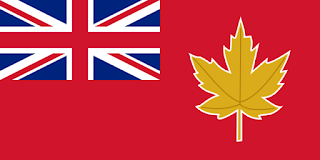
Personally, I have a soft spot for the Red Ensign, and not just because maybe secretly I wish to see the British Empire rise and rule the world again. But, rather, I see it from a historical point of view: this flag, variations notwithstanding, the one that Canadian soldiers fought World War One and Two under. There are issues with it, namely in that it prioritizes four European nations (and, in fact, with the Union Jack it represents England, Scotland and Ireland twice) as the "founders" of Canada. A modern version would have to find something else. My personal vote would have been a Red Ensign with a maple leaf of some kind, like this:

And finally, two other proposals:

The "Pearson Pennant" proposed by Prime Minister Lester B. Pearson in 1964 to encapsulate the motto "From Sea to Sea" (and worthy of any alternate Canadian flag, I say)


And the "Unity Flag" first made in 1995 during the second Quebec Referendum, with the Blue representing the proportion of Quebecers in Canada. Though, I honestly would feel a bit insulted if all I got was a couple narrow blue bars but, hey, Quebec remained in Canada then (by a squeaker), so maybe it worked.


I plan to do Flag Friday's more often, and maybe with some flags designed for Alternate History scenarios. So if you have a flag you want to suggest, message me on Twitter (@tbguy1992) or email me at tbguy1992@gmail.com.

Friday, March 11, 2016

Flag Friday: Alternate American Flag

The other day, I asked on the Twitters and Facebooks what an American flag without Stars and Stripes would be like.

Well, frankly... No one knows. You could take one or the other off, but not both, it seems. But over all, most Alternate American flags are a variation of stars, stripes, red, white and blue.

So, here's my version.


The green is supposed to represent the boundless land of the US, while the blue is for the Mississippi and other rivers which unite the country. A simple eagle from the Great Seal, and the motto of "E Pluribus Unum" at the bottom, could possibly be removed.

I'll be honest, looking back at it just an hour after making it, it's so-so. Yes, I got rid of the stars, but the stripes in the shield are still there. But I like the idea of an eagle in the centre.

I guess the main thing is that, really, anything can be made into a flag. I just wish that people would try to make something other than stars and stripes when making America in Alternate history.

So what do you think? What would your American flag without stars or stripes look at? Leave a comment or send me a message on Twitter, @tbguy1992.

Friday, February 12, 2016

Flag Friday: The Danube Confederation

It's another Flag Friday! (Mostly because I have nothing else planned at the moment).

Therefore, I want to look at another flag that was made for one of my timelines, this time the Danube Confederation in my AltHistory Wikia TL, One Day in Sarajevo.


The Danube Confederation is a majorly reformed and rebranded Austro-Hungarian Empire. With the POD being that Archduke Franz Ferdinand is not assassinated, and his uncle, Emperor Franz Joseph dies in 1915 instead of 1916, Franz becomes the new Emperor. However, his prickly personality, especially against the Hungarians (and his support for the other nationalities in the Empire, such as the Slavs and the Czechs) lead to the break down in the 1917 Austria-Hungarian Compromise, the separation of Hungary from Austria, and the outbreak of Civil War. Russia, wishing to see their Balkan rival dismantled, supports Hungary, while Kaiser Wilhelm II supports the Austrian portion, and it inevitably leads to a full scale European War. Germany, with a few years to patch up relations with Britain is able to convince the UK to stay out of the war (not invading Belgium helped) and Britain having just dealt with an Irish Insurrection, was in no shape to go fight in Europe. Still didn't help Germany much, as the Kaiser's indecision of what to do, and the military's confusion without the Schefillen plan to guide them in a war, lead to the French invading and occupying Germany territory in Alsace-Lorraine and crossing the Rhine River.

Emperor Ferdinand, taking the opportunity that the war, has the Imperial Parliament, minus the rebellious Hungarian members, to pass a series of laws granting equal rights and national assemblies to ten of the most important nationalities in the Empire: German, Czech, Slovak, Ukrainian, Croatian, Serbian, Romanian, Polish and Slovenes, with the Hungarian national assembly not officially being founded. These new assemblies are given a large amount of power, and representatives in the Imperial Parliament. Emperor Ferdinand retains his title, and in June 1918, the Danube Confederation is declared into existence.

The troops that the various national assemblies raised are put under a unified command, which is also placed under combined German-Danubian command. With this reorganization and morale boost, Austria is eventually triumphant in the Civil War, and plays a large part in fighting Russia and Italy with German, and later Ottoman and British help. (The British came into the war in 1919 on Germany's side due to French attacks on British shipping). The war ends in 1921, with the Germans, Brits, Danubians, Ottomans and other allies defeating France, Russia (which goes communist), Spain, and other allies. The US stayed neutral.

After the war, the process of rebuilding the Danube Confederation takes billions of dollars and lots of soul searching. The Hungarians resent having much of their power taken away (Hungary is officially reduced in size, and mostly only contains the Magyar majority areas, similar to OTL Hungary's size), but have a lot of autonomy thanks to their National Assembly.

Emperor Ferdinand is regarded as a hero for reforming the Austro-Hungarian Empire, and in the 1920s matures into a more constitutional monarch, and many of his more extreme views, such as his hatred of Hungarians, has mellowed over the years. His role as Emperor, and the ruling monarch of the Hapsburg Dynasty that formed the empire to begin with, is seen as his greatest strength and his sole source of authority and power, even more than the constitution that was eventually written up. But his death in 1939 (his last words in a medically induced stupor being to his already deceased wife Sophie: "Sophie, please live for our children!") throws the carefully constructed empire into chaos, just as a new, more destructive war is about to break out...

And that's actually about as far as I've gotten with the TL so far.

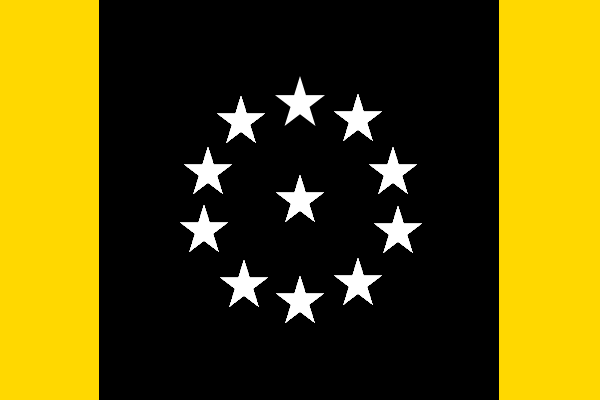
The flag though took a lot of time to come up with, and was the best of several suggestions made by fellow AltHistory Wikians. The black and yellow are the traditional colours of the Habsburg Monarchy, and the only colours that were believed that most Danubian citizens would be able to accept without favouring one nationality over another. The 10 stars in a circle represent the 10 major nationalities of the Danubian Confederation: Austrian/German, Hungarian, Czech, Slovak, Ukrainian, Croatian, Serbian, Romanian, Polish and Slovenes, with the centre star standing for their unification into one body.

Other versions of the flag had the stars rearranged differently, the off sized tricolour being a try tricolour, or a simple bicolour, and some with a blue strip in the middle between the black and yellow to represent the Danube River that holds the countries together. But most of them were more trial and error versions, and this is the best version that we came up with.


But what do you think? Does the flag make any sense at all for a reformed Austria-Hungary? Or if you have a topic or idea you would like me to talk about, please leave comments below, email me at tbguy1992@gmail.com, or tell me on Twitter @tbguy1992.

Friday, January 22, 2016

Flag Friday: Assiniboia in French Trafalgar, British Waterloo

A while ago I talked about my timeline on the AltHistory Wikia, French Trafalgar, British Waterloo, and some of the things I would change in it now. However, I like talking about it, even though I haven't done as much as I should have in the past few years to expand it. But soon I plan to get back into it. Not going to let eight years of work go to waste!

And for today, since this is, according to many an Alternate Historian, Flag Friday, I want to talk about some of the unique flags I made over the years for the countries in FTBW, and the brief histories I made for them. I'm not going to go into a huge amount of detail, and if you want to know more, follow the articles that I link. Going to do one a week though, so I don't overload you guys!


This is one of my favourite creations I've ever made in anything. Assiniboia is a country in North America, covering most of what is now Manitoba, Saskatchewan, Alberta, the Northwest Territories, Nunavut, and the western half of Ontario. It was founded by Native groups, namely the half native/half European Metis, lead by Louis Riel, with the help of the US in the 1870s, taking over the vast Rupert's Land of the Hudson's Bay Company to make their own nation. This was to prevent Canada from stretching from sea to sea (in this TL, not only had the US been divided in two by an ATL American Civil War, but it was prevented from expanding to the west because of the British who took over half of the Louisiana Purchase in a failed War of 1812). It becomes a mixture of European settler colonies, Native and Metis confederacy, British Westminster and American Republic in government. It's biggest industry for decades was agriculture, and increasingly resource extraction and transport, the capital Winnipeg becoming a huge railroad transport centre, connecting Canada, Alyseka and the US together.

Assiniboia is a long time ally of the US, and later of the Russian colony turned republic of Alyseka, the so called "Triple A Alliance," and sided with the US in numerous wars, including the Second and Third Global Wars (ATL's First and Second World Wars), and though a small, thinly populated country, Assiniboian soldiers were identified as some of the bravest and strongest in North America. In the 1930s, as the Great Depression roared through the world, the Assiniboian government took a gamble and invited movie studios north. While it didn't solve the crisis, the combination of low taxes, cheep labor, and vast open spaces quickly made Assiniboia the premier entertainment center in the world, with over 75% of English language films in the world being made by studios headquartered in Winnipeg, Brandon, Wascana (OTL Regina) and Calgary. President Tommy Douglas lead the nation through the horrors of the Third Global War, and for years modernized the country, bringing in universal healthcare and other welfare programs, while re-orienting Assiniboia to being an independent voice in the world stage: Allied with the US, but able to work with around the world. The US relied on Assiniboian diplomats and services so much that the Ministry of Foreign Affairs was often called the "US Department of State, Northern Branch."

Today Assiniboia is a wealthy, social-democratic nations member of the Organization of Sovereign Nations (ATL UN) and the Juneau Pact (anti French and Japanese Democratic alliance headed by the US and Russia), with a strong cultural and economic influence on the world, especially when the oil sands was discovered in the Athabaska region. While only having a bit less than 13 million people in the last election, Assiniboia is recognized as one of the richest and most influential "middle powers" in the world.

As for the flag: the Green background represents the vast land, agriculture, and prosperity, while the white infinity symbol has several meanings: the belief that the Metis people, and Assiniboia, will go on forever, as well as the two circles being joined represents the unification of two peoples, Europeans (especially the French and English) with the First Nations that lived in North American before hand, in peace and harmony. Mostly. Blue and Red versions of the flag are in existence, with red Metis that served with the Hudson's Bay Company as traders and trappers, with the red standing for those that served with the rival North West Territory.


But what do you think? Is Assiniboia basically my version of a "fan wank?" Or if you have a topic or idea you would like me to talk about, please leave comments below, email me at tbguy1992@gmail.com, or tell me on Twitter @tbguy1992