Hello ladies and gentlemen, I'm back after a very, very long break.
I'm not going to get into everything I've done since I last posted since... December 2017. Ohh...
Anyway, today I'm going to write a short essay on, as you can tell from the title, on why Fascists and Racists never win in real life, or at least in the long wars and in the long term in general. And I mean capital F and R Fascists and Racists, those that are so blinded by their hatred and perceived superiority that they couldn't comprehend giving others a chance, or even to use them to their greatest effectiveness. I classify lowercase r racists as more the "Well, they are different, and I don't like them, but they can fire a gun or make stuff, so I'll use them." Still not good by any stretch of the imagination, and who still exist today, but much, much better than the Nazis.
This thought as come from a book I've been re-reading recently, Why The Allies Won by Richard Overy. It's a very well written book that dispels a lot of the myths of the war, such as the sheer amount of resources and production that the Allies had on their side allowed them to win. It was more that the Allies managed to reform their economies, tactics and worked together as well as they could, and did so very quickly, while the Axis, especially German, mismanagement of their resources, failure to adapt as their foes did, and the almost constant backstabbing and squabbling of the upper leadership that Hitler couldn't, or wouldn't control.
But there is another aspect that comes up time and again in the book, and can be further extrapolated to other historical entities and time periods, to show why the Fascists and Racists never win their big wars... usually.
And that is, well, their racism.
When Hitler invaded the USSR, his soldiers were greeted as liberators, especially in the Ukraine. They believed they had been freed from the cruelty of the Soviet Union and Stalin's paranoia and megalomania, the death and destruction of the Holodomor still in memory. But this lasted all of five seconds before the SS death squads turned up and began to execute the Jews, Communist party officials, and treated the population as inferior beings, Untermenschen, in the Nazi's twisted view of race. Overnight, Ukrainian and Baltic peasants that were once cheering the arrival of the Wehrmacht were now taking up arms to sabotage it with brutal partisan warfare. Red Army soldiers were driven, not simply by the fear of the NKVD to make defeatists disappear into the Gulags, but by the hatred of the Germans, their brutality, the mass death and destruction they left in their wake. Civilians that raced east to avoid the Germans, to work in the hastily re-assembled factories set up in the Ural Mountains, put up with the starvation rations and deadly working conditions of the factories in sub-zero temperatures to turn out the crude by effective tanks, airplanes and guns that would slow down, halt, and eventually drive back the Nazis because of the righteous fury of the German's and the barbarity they unleashed.
Now, imagine, for a moment, that Hitler let his racism take a back seat to pragmatism, to treat the Slavs as possible allies? How many divisions of anti-Communist, anti-Stalinist Ukrainians as allies? Enough to reach the Caucasus as the oil there? To capture Stalingrad? To reach the fabled Arkhangelsk-Astrakhan Line? Repeal the Allies on D-Day? Or even just to work in the factories of Germany, not as slaves who were starved, beaten and tortured to death, but as willing workers, freeing more manpower to expand the Reich? Instead, tens, if not hundreds, of thousands of German soldiers would fight cat and mouse battles with partisans, who would destroy the railways, kill the horses, slaughter their enemy in barbaric ways to drive them out of the country.
This doesn't mean that the moment that the Soviet's surrendered, and the US and UK agreed to peace, that Hitler couldn't then turn around, backstab his Slavic allies, and enslave them all, drive them from their land and give the rich fields and pastures of the vaunted Lebensraum to pure Germans. But because Hitler and the Nazi's sought to fight the war against both armies of the Great Powers and their perceived racial inferiors in the land they conquered at the same time, they lost both fights.
This goes even further back, to the first target of Hitler's hatred, the Jewish people. Starting as soon as he took the office of Chancellor in 1933 by driving out tens of thousands of the smartest and best educated citizens of Germany, the scientists and engineers like Albert Einstein, from their professions, their homes and businesses to make room for his Aryan master race. Then, as he strengthened his power, he proceeding step by step, with the yellow stars, Kristallnacht, the Ghettos, to finally the horrors of Auschwitz and the Holocaust, the Nazi's killed six million Jews, trying to erase them from history. But even in this, the Nazi's sabatoged themselves, tying up precious transportation services like railways to send hundreds of thousands to their death. By sending Jews to the death camps was given a higher priority than even food and ammunition to the soldiers on the Eastern front. This shouldn't, and isn't, to say that the Holocaust had a silver lining. It was a horrible, inhumane, and criminal endeavour, but in their blind racist rage and hatred to kill as many Jews as possible, they put in place the downfall of the Third Reich.
But even more than that, because it was Jews like Einstein that explored atomic power, Hitler classified it as "Jewish" science, and refused to give it the funding and resources that would have allowed them build an atomic bomb, a true wonder weapon that maybe could have turned the tide of war. And the Jewish scientists and engineers that escaped would be instrumental in the Manhattan Project to develop the bomb that would be used on Japan.
It's difficult to say that, had Hitler just not been racist and given the German atomic programme the resources it needed to develop the bomb. It took the US, the richest country in the world in 1945, nearly $2 billion, along with the work of 150,000 highly skilled men and women, to build the first one. Germany, while on the verge of being an economic superpower, wasted much of their resources on jet engines, super tanks, ballistic missiles, and many, many Wunderwaffen projects that were years ahead of it's time. It's incredibly unlikely that the Nazi's would have gotten the A-bomb first, but they would have had a much better shot had racism not blinded them.
The same thing happened the Japanese, who considered the many people they conquered as inferior to themselves, especially the Chinese, and suffered the brutal struggle in China that lead to their war against the US, Britain, the Dutch and others. And this was just some of the brutal atrocities that they inflicted on the people they conquered. And even further back in history, with the Confederate States in the US Civil War, they kept a third of the total population of the Southern States in bondage, when they were already had a smaller population and resource base compared to the North. And on and on throughout history, it always seems that the empire that enslaves and brutalizes a large portion of their subjects that, in the long run, die out. The Spanish Empire set up in the Americas crumbled once the locals, and those that were Spanish descendant but had lived in the colonies and were considered inferior to those born in Europe, saw that the Spanish were not invulnerable after Napoleon invaded. Napoleon himself failed to retake Haiti in 1804, most due to disease, but also to the army of former slave Toussaint Louverture.
But then, of course, there are the times when those that believed themselves to be racially superior did win: the British built a massive empire where the sun never set, and tried to turn their new subjects into Christian and British and erase their old cultures. The Russian Empire tried to make the many, many people they conquered in Eastern Europe and Central Asia into Russians, a policy continued by the Soviets with very mixed results. Same with the US as they spread westward and drove the Native Americans into reservations. Even Canada tried to turn the Aboriginals in their lands into "proper" citizens (i.e.: Christian) through Residential Schools.
But all these empires and nations, however, didn't simply try to systematically kill and brutalize those they conquered like the Nazis, and now the long, difficult process to try to make up for the brutality and racism of the past is ongoing around the world. Even during the age of "scientific racism," the British used troops from their colonies, like India, to fight their wars. Native Americans served in the armies of the US and Canada in the World Wars: the famous Navajo Code Talkers and Tommy Prince, the most decorated Canadian soldier of the Second World War. And in Jim Crow America, African Americans served in the US military, such as in Harlem Hellfighters, and in the factories that turned out the guns and tanks and planes of the Arsenal of Democracy.
So, yes. Fascists and Racists (almost) never win their wars. That doesn't mean that racists societies don't win, but they will at least let their second class citizens to serve in their armies and fight. And oftentimes, it leads to the destruction of said society after the war as civil rights or decolonization rears it's head to try to make humanity just a little bit better.
Showing posts with label Real History. Show all posts
Showing posts with label Real History. Show all posts
Saturday, July 13, 2019

Tuesday, September 1, 2015
Real History #3: The Rise and Fall of a Prairie Town: Napinka, Manitoba
Last Monday, August 24, 2015, my grandmother, Gladys Pearl Bugg, passed away. A kind, remarkable, woman fell asleep one last time. Born in 1931, married in 1951, and had five children, 10 grandchildren, 10 great-grandchildren, innumerable friends, and many fond memories.
In memory of her, I've decided to post this article, one I worked on for a local heritage group for a future history book, about the small town where our family grew up around, Napinka, Manitoba, Canada.
Note: unless otherwise stated, all the towns mentioned in this article are in Manitoba. Promise!
 |
| I really, really, really wish I had a better program for making maps. All that empty Northern space to point out, yes, this is Manitoba... |
The story of Napinka is one tied very
closely to that of the railroads in a way that no one alive today can fully
comprehend to this day of the car and airplane. Napinka seemed destined for a
time to become the most important town in the region when the first settlers
set up homes in 1881 and 1882 as the excitement of the railways grabbed hold of
the country. It would take until July 1891 and years of broken promises and
missed deadlines – even leading to the electoral defeat of a Member of the Manitoba Legislative Assembly (MLA) when he
promised the railroad by 1888 – before the Canadian Pacific Railway did lay the
tracks they promised to Napinka from Kemnay as part of the Estevan Subdivision, terminating in Estevan, Saskatchewan.
A year later, the line from Deloraine had been finished to Napinka, much to the
disappointment and anger of Melita, who sent a delegation to Winnipeg to argue
for the junction of the rail lines in Melita to no avail.
The next sixty years where the heyday of
Napinka. Trains came in every day from Brandon, Winnipeg, Estevan and the many
small towns along the line. To service the trains, the CRP built a water tower
pumped from behind a dam the railway built on the Souris River, with a ball on
top that would let people see how much water was available. A coal dock, tool
shop, round house (found to be too small when originally built) and bunkhouse
were also built to serve the CPR in Napinka. The passengers and crew on the
trips that stopped overnight in Napinka used the hotels and stores built along
Railway Avenue. In 1892, an article in the Brandon
Sun mentioned Napinka having “…two general stores, three hardware stores,
two butcher shops, one flour and feed store, one watchmaker, two dressmakers,
builders, coal and wood dealers, one elevator, two lumber yards, a drug store
and a barber shop…” Boarding houses, two hotels including the infamous Leland
and the Russell, two banks, a blacksmith, doctors, a laundry operated by a
Chinese immigrant, a Massey-Harris dealership, and eventually, with the arrival
of the automobile, two garages were also set up in Napinka after this article
was written.
 |
| Main Street, Napinka. Though, it's not actually called "Main Street," it's Railway Avenue. Because the CPR loves pointing out how important they are. |
A beautiful two story stone school house,
built from 1897 to 1900 and constructed of stone hauled from south of the
present Highway #3, is an example of the pride and feeling of prosperity that
grabbed hold of Napinka. On May 28, 1908, Napinka was officially incorporated
as a village, with a population of nearly 400.
Sports teams, social clubs, and women’s
organizations were set up in these early days, bringing amusement and community
to the inhabitants of the town. An open air skating and curling rink was built
in 1896, while a newer curling facility was built in 1906, and curlers from
Napinka achieved great success in bonspiels across Manitoba. Three churches,
the Zion Methodist, Presbyterian, and Anglican churches were in Napinka at the
turn of the century, though the Methodist and Presbyterian would unite to form
the United Church in 1917, nine years before the United Church was formed
nationally. The Napinka Women’s Institute was established in 1921 and a Red
Cross branch was set up in 1941. The Faith Rebekah Lodge was set up in Napinka
in 1947, while a Beef and Home-Ec 4-H club were only set up in the 1960s, along
with the Napinka Explorers and a Canadian Girls in Training (C.G.I.T.) branch affiliated
with some of the churches in town.
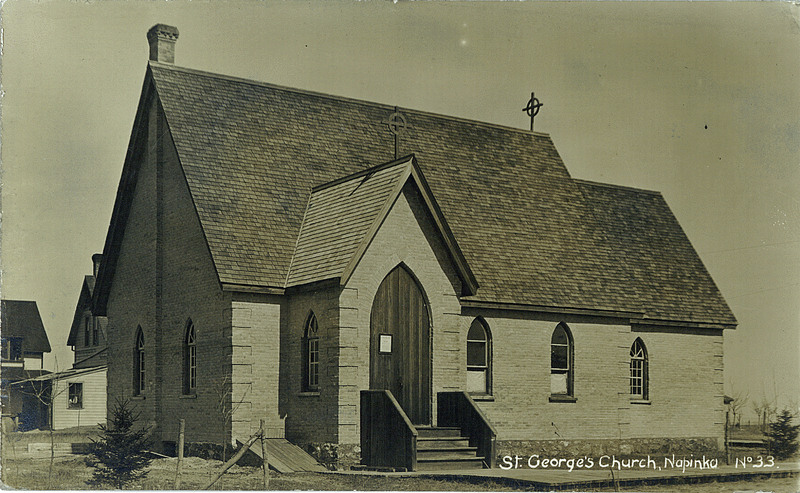 |
| Out of the three churches, only this one is still standing... so I guess it wins the "Still Standing Prize?" |
The ambitious residents, when the need for
a baker became apparent, decided they wanted something grander and offered
$5000 for someone to set up a gist mill, which was a sign of progress in small
towns across Western Canada at the time. Although land was set-aside just
outside of town, no gist mill was ever built.
Even during the hard years of the World
Wars and the Great Depression, Napinka continued to thrive, mostly thanks to
the railway. For a few years after the young men returned from Europe in 1945,
things looked like they would continue. A new community hall that is still
active to this day was built in 1946, while a skating rink was erected in 1953.
However, two incidents in the 1950s sounded
the death knell of the town. On March 6, 1951, a fire destroyed the Russell
Hotel and, possibly more importantly, it’s beer parlor, damaging business in the town. Even more
devastating, the use of the Diesel engine in trains, and the rapid
“dieselization” of the CPR fleet starting in 1957 lead to the end of the
classic days of steam trains. Declining passenger and freight revenue on these
same trains as the personal automobile and the grain truck took over previous
duties that the train did so well resulted in many of the routes being suspended
in the late 1950s and early 1960s. The water tower and coal dock were torn down
in 1963, while the station remained just long enough to be used for filming in
the 1985 NFB film Daughters of the Country – Part III, Places Not Our Own, but was moved soon after to a place
near Shilo, and turned into a personal home.
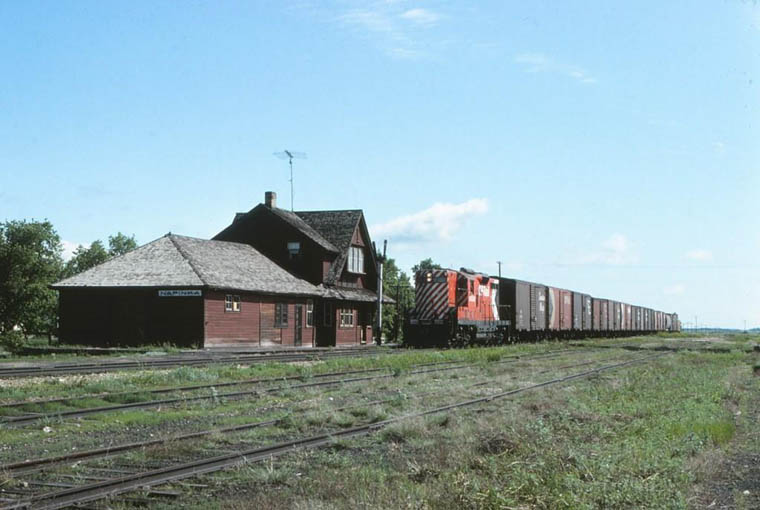 |
| Someday, I really, really, really want to get that train station back. If just so I can dress up and look at my pocket watch worriedly and shout at people. |
Businesses that were long staples of
Napinka began to disappear: the Blacksmith closed its doors in 1957, the two-story
building being divided: the top half that was used as the church, school and dancing
in the early years, was taken off and was sent to Virden, the bottom to be used
as a cattle shed. The Co-op left in 1962, while the last butcher closed in
1961, the building being used as the Legion in Napinka for many years, until it
was moved. The poolroom and barbershop where closed in 1962, with the building
torn down 14 years later. Two elevators out four at the height of Napinka
remain along the tracks, but were closed by 1984, and are currently owned by
Tilbury Farms from Melita. The Village of Napinka itself voted itself out of
existence on January 1, 1986, all duties being taken over by the Rural
Municipality of Brenda. At this time, only 132 people called Napinka home. One
of the last things the Village of Napinka did before it ended was install water
and sewer lines for the village.
The school, long a source of pride, was
also shut down. Though an addition had been built in 1959-60 that added more
classrooms, a library and indoor plumbing, consolidation of the rural schools
lead to the closing of the high school in 1968, and later the last elementary
classes were ended in 1975 with all students being bused to Melita. The old
stone building is now empty, while the newer addition was turned into the
Drop-in-Center, providing a place for coffee in the mornings, a small library
to serve the community, and for family and community events.
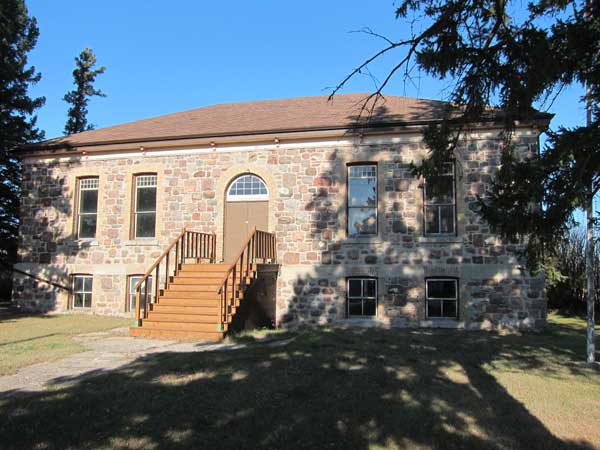 |
| This is a very impressive building when you look at it up close. Take my word for it. |
The skating rink fell down in 1996, and was
never rebuilt; the curling club had ended in 1973, and it’s building torn down
in 1977. Green’s Garage, the only business in Napinka to be held by the same
family for it’s entire existence, finally closed its doors for good in the
1990s. The old two-story brick post office, formerly the Bank of Montreal when
it was first built, was torn down in 2010, though for many years Bodkin’s
Grocery Store was Napinka’s post office, but eventually it too closed in 1990
and now only a lonely row of community mailboxes is all that is needed. One of
the last remnants of Napinka, an old Livery barn, was only taken down in 2013
and the Zion United Church was demolished a few weeks before this article was
written in 2014. The Anglican Church had been purchased years before for
personal use by a resident in Napinka.
The story of Napinka isn’t one that is
unique: every small town in Western Canada has faced this problem of
depopulation and a lack of purpose in the era of cars and airplanes. While some
managed to survive, many others have died out and are now nothing more than tiny
dots on a map. In a town that once held so much promise and ambition, Napinka
still holds on to the past; the old fire hall with two horse drawn fire wagons
can still be looked at, while the school house still stands on a beautiful lot
of trees and flowers. Trains still rumble through Napinka, though they are now most
likely carrying grain, coal and even oil. Though in the end this is a sad
story, the memories of the glory days of the early twentieth century is still
strong in the residents of the town who remember the magic of a steam train
sliding in gracefully next to the station on a puff of white smoke and dozens
of people disembarking to take in the charm and vitality of a small town with
so much promise.
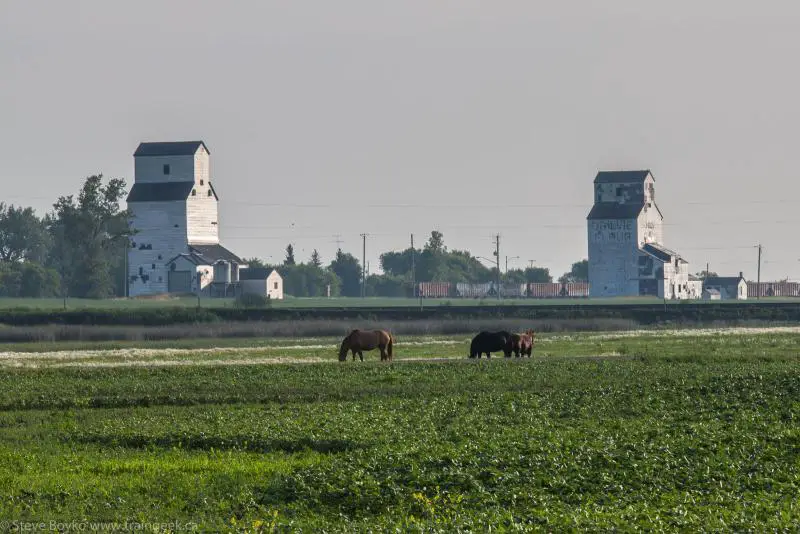 |
| And if you don't mind the occasional train, being an hour away from the closest city, nothing but cows and canola as far as the eye can see, internet that isn't always reliable... you can always move here! |
Throughout the early years of Napinka, the
trains brought in some people that have since become famous;
-J. S. Woodsworth: First leader of federal
Co-operative Commonwealth Federation (CCF, later NDP, 1932-42), leader of
Winnipeg General Strike 1919 - Methodist Minister in 1897.
-Seymour J. Farmer: Mayor of Winnipeg
(1923-24), City Councillor (1928-29) Leader of Manitoba Co-operative
Commonwealth Federation (CCF, later NDP), MLA from 1922-1949 – C.P.R. clerk
-Poet and performer Pauline Johnson, c.1908
Sources: Brenda History Committee. Bridging Brenda Volume I. Altona,
Manitoba; Friesen Printers, 1990. Page 286-293
Friday, August 14, 2015
Real History #2: The Winnipeg Grenadiers and the Battle of Hong Kong
Tucked into a corner of the Military Room
of the museum I've been working at this summer in Melita, Manitoba is a World War Two uniform that, at first glance, is very
similar to the other ones that had been donated or loaned to the over the decades. The
khaki uniform by itself is unremarkable, but when you look at the three ribbons
for medals and the patches on the sleeves, another story is told.
Unfortunately, this story is of war, terror and unspeakable atrocities that the
wearer would have gone through. For the name of the unit, in white letters on red is "WINNIPEG GRENADIERS," and below that, a very "Oriental" facsimile of the letters HK, standing for Hong Kong.
 |
| It's amazing all the things you will find in small town museums. |
The Grenadiers was first established in
1908 as the 100th Regiment, with the Headquarters in Morden and the
eight companies in different towns throughout southern Manitoba. In 1910 the
entire regiment was moved and based in Winnipeg, and was renamed the 100th
Winnipeg Grenadiers. In 1920, after World War One, the regiment was finally
renamed as the Winnipeg Grenadiers. While the regiment itself didn’t serve in
World War One due to the establishment of separate battalions for the Canadian Expeditionary Force, the Grenadiers were allowed to “perpetuate,” or preserve
the battle honors and traditions of three battalions from the CEF: the 11th
Battalion, the 78th Battalion (Winnipeg Grenadiers) and the 100th
Battalion (Winnipeg Grenadiers). In 1936, the 10th Machine Gun
Brigade, CMGC (Canadian Machine Gun Corps) was amalgamated with The Winnipeg
Grenadiers, and now the unit was officially The Winnipeg Grenadiers (MG). Other units have been formed and merged and broken away over the years, so to make it easier, here's a picture. If you can't read it, here's the link
 |
| Told you it was complicated... |
When World War Two broke out in September
1939, The Winnipeg Grenadiers was activated for war duty and was renamed First
Battalion, The Winnipeg Grenadiers. A second Battalion was set up to serve as a
reserve force and remained in Winnipeg for the duration of the war. The First
Battalion was sent to Jamaica and Bermuda for garrison duty from May 1940 to
October 1941. But in autumn of 1941, the Canadian government chose the Winnipeg
Grenadiers as part of “C Force,” a small unit of Canadian soldiers offered to
Winston Churchill, Prime Minister of the United Kingdom and one of the most interesting people ever, for the defense of
Hong Kong. C Force also included the Royal Rifles of Canada, originally from
Quebec, though they had only served in garrison duty in Canada. In all, 1,977
soldiers and headquarters personal under the commander of Brigadier John K. Lawson
were sent to Hong Kong on two ships, the troopship Awatea and armored merchant cruiser Prince Robert. With other British, Indian and local Chinese troops,
over 14,000 soldiers were now in place to defend Hong Kong.
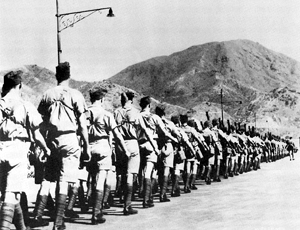 |
| Everything will be fine. Right guys? |
Hong Kong had been a British colony since
1841, captured from the moribund Qing Empire in the First Opium War, and served
as an important trading base with China and Asia for decades. However, with the
end of an alliance between the United Kingdom and the Empire of Japan in the
1920s, British military officials realized that Hong Kong would be nearly
impossible to hold in the face of Japanese attack. These fears only increased
after 1937 with the start of the Japanese invasion of Mainland China, which
lead to the surrounding of Hong Kong.
 |
| British Hong Kong: For all your "Overthrowing Empires with a Highly Addictive Drug" needs! |
When war broke out in Europe in 1939,
Winston Churchill and his military advisors decided to reduce the size of the
garrison of Hong Kong to a “symbolic” size. But in September 1941, that
decision was reversed. It was believed that a fortification of the colony
serving as both a possible deterrent to Japanese aggression and reassurance to
Nationalist China leader Chiang Kai-shek that Britain would support them.
On December 8, 1941, those hopes proved
false. Eight hours after the attack on Pearl Harbor in Hawaii (which happened
on December 7, 1941, as many people I'm sure are going to tell me. However, both events were on opposite sides of the
International Date Line, hence the differences in dates) 52,000 men of the
Japanese Twenty-Third Army invaded Hong Kong with no warning, catching the
British forces unprepared. With only five planes (the closest squadron being
over 2000 kilometres away) and three destroyers, two of which were soon sent to
Singapore. The British were outnumbered 4 to 1, and the Japanese forces had
recent combat experience fighting in China, while most of the British, Indian
and Canadian troops were garrison units with little or no combat experience.
The Battle for Hong Kong lasted 17 days,
during which time the Allied forces were forced from the small enclave on the
mainland to the island of Hong Kong itself, and the defense divided into two
brigades to support the other. The Japanese landing on the island on December
18 was fiercely fought, and the West Brigade under Canadian Brigadier Lawson
were overrun, with Lawson himself losing his life, the most senior Canadian
officer in World War Two to have died in battle. By Christmas Day, 1941, the
remaining British and Commonwealth forces surrendered. Of the 14,000 troops,
2,113 were killed or missing, 2,300 wounded, and 10,000 were captured by the
Japanese.
 |
| Because I can't describe everything that happened... here's a map. |
Only 2000 Japanese soldiers were killed, with 6,000 wounded. One of
those killed was Company Sergeant-Major John Robert Osborn, who was awarded the
Victoria Cross, the highest decoration that can be awarded in the British
Commonwealth, for heroism during the battle. When a grenade was thrown into the
house he and several soldiers were fighting from, Sergeant-Major Osborn shouted
to his comrades to stay down, and he jumped on the grenade, sacrificing himself
to save many others.
Those that were captured faced horrific conditions and treatment at the hand of
the Japanese, who saw the prisoners of war as “subhuman” for not fighting to
the death, and therefore having lost all respect and rights. They were forced
marched and kept in unsanitary, overcrowded conditions for years. Soldiers were
beaten, starved and even killed at the hands of the Japanese soldiers. Japanese
soldiers also massacred hundreds of soldiers and civilians during the battle,
and the populace was subjected to rape, violence, starvation and oppression
until the surrender of Japan in September 1945. Fortunately, the man who wore the uniform donated to the Museum lived to see his home in rural Manitoba after the war.
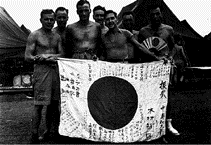 |
| I really have nothing funny I can say about the treatment the POW's received... so here's a picture of when they were liberated |
The 1st Battalion, Winnipeg
Grenadiers, was re-established in 1942 and served in Canada as part of the
defense of Canada, before being sent to Alaska and later England as a training
unit for the rest of the war. After the war The Winnipeg Grenadiers served as
part of the active army until February 28, 1965, when it was placed on the
“Supplementary Order of Battle,” meaning that it is virtually disbanded, with
no personal serving under that regiment. However, should the need arise, the
regiment can be reformed and “…it will take its old place in the order of
precedence and its colors, traditions, and battle honors will remain as if
there had been no interruption of service.” So maybe someday The Winnipeg
Grenadiers, the first Canadian military unit to see fighting in World War Two,
will be established again.
Friday, August 7, 2015
Real History #1: CONELRAD, or the Last Thing You May Haver Ever Heard in the 50s
On Tuesday, for the inaugural article for this blog, I've outlined a scenario where the USSR never developed an atomic bomb. Part of the reason for that article was this one, which I wrote on the behalf of a local museum for the small town weekly newspaper. That is part of the reason that I started this blog in the first place!
For those to young to remember, the Cold War was a time of mistrustful peace, ideological conflict and the overhanging
fear that at any moment, nuclear Armageddon could be unleashed, resulting in
the destruction of civilization, if not all of humanity, in a blink of an eye.
If you ask those who grew up in the 1950s and 1960s, they can still tell you
about the “Duck and Cover” drills, where they would duck under their school
desks when the sirens went off to warn of air raids. This wasn’t necessarily to
protect you from the fallout, but the burns and falling debris. So, no, school
desks won’t protect you from radioactive fallout!
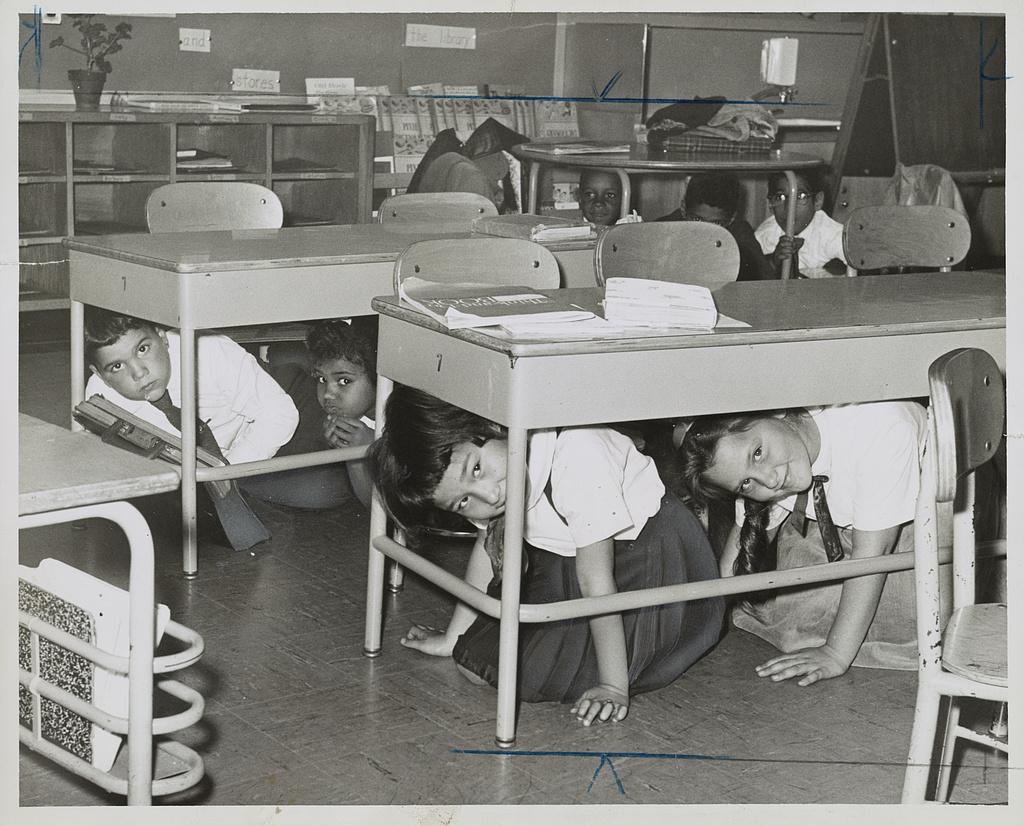 |
| Don't worry kids! You'll be fine! |
The period between 1945 and 1991 was
dominated by the political, economic and military conflict between the nations
allied with the United States of America and the Union of Soviet Socialist
Republics, known better as the USSR. The US, Canada, Western Europe (known as
NATO) and dozens of other nations around the world were in favor of capitalism,
while the “Warsaw Pact” of the Soviet Union and the states of Eastern Europe,
China and Cuba pushed Communism as not only a viable alternative, but the future
for the whole world.
At first, only the US had access to nuclear
weapons technology, but by 1949 the USSR had it’s own nuclear weapon, partially
thanks to spies and informants in the American and British Manhattan Project
that passed information to the Soviets, as I mentioned early this week. Fear and paranoia in America about
Soviet spies lead to the “Red Scare,” lead by Senator Joe McCarthy and the
House Un-American Activities Committee, but more directly it lead to panic that
the Soviet Union could now bomb the US. In 1951, President Harry Truman therefore established a new system to warn the American people in the event of
a nuclear war, CONELRAD.
 |
| Pretty creative logo, huh? |
Before 1951, there was no system in the US,
much less Canada, to warn the American people over radios or the new medium of
television. While radio stations did interrupt broadcasting during the attack
on Pearl Harbor in December 1941 and the first successful tornado alert was
sent over the radio in 1948, there was no unified, national system.
CONELRAD was the first such system.
Standing for CONtrol of
Electromagnetic RADiation, it
had a two step goal: to warn the American people, and to throw off the nuclear
armed Soviet Bombers sent to attack American cities. In the event of a nuclear
attack, all TV and FM radio stations would go off the air, and the few stations
left on the air would broadcast at 640 or 1240 kHz for a few minutes then shut
off, then another station would take over for a few minutes before it shut off
and another station would take it’s place. This was designed to confuse Soviet
bombers that might be using radio frequency detection equipment to find
American cities, apparently in the belief that USSR pilots couldn’t find the
big, sprawling cities and military bases that were their targets! In order to
alert stations in the “Key Station System,” an ad-hoc approach of shutting down
and turning on the transmitter of the main stations several times before
sending out an ear piercing shriek actually lead to failures and false warnings
when transmitters, not designed to be rapidly turned on and off, failed to restart.
 |
| Posters like this were a major part of the information campaign issued by the Federal Civil Defense Administration of the US during the early Cold War. |
Between 1953 and 1963, all radios made in
the US had the symbol of Civil Defense (a triangle inside a circle, often with
a CD) marked at 640 and 1240 AM. When the alert was issued, everyone was to
turn to one of these stations to hear pre-recorded instructions and information
from the Board of Civil Defense about how to survive in a nuclear exchange: do
not go outside in fallout, turn off gas, save water and ration your food were
the primary messages. When many of the messages were later de-classified,
scientists discovered that the information about fallout and nuclear blasts provided
in the broadcasts were almost totally wrong, which raises questions about
exactly how many people would have survived following CONELRAD’s instructions.
And as with all technology and human error, we would never know if CONELRAD
would have fully functioned in a nuclear war, or if people would listen to the
messages that were sent, as most asked that parent's not worry to find their kids if they were in school, stay off phone lines for emergency personal only, and, if there was not enough time, not to evacuate and clog up the roads. All of these things would have been counter to instincts would suggest. I'm unsure if CONELRAD, even if it worked flawlessly to alert people, would have saved many lives.
 |
| This is the radio that I found at the museum I was working at this summer that sparked this article |
 |
| Here you can see the "CD" and triangle that marked where to turn the radio to in the event of a nuclear war. |
Thankfully, CONELRAD, nor its successors
have been used to warn the American people of a nuclear war. CONELRAD was shut
down in 1963 after the Cuban Missile Crisis when intercontinental ballistic
missiles (ICBMs) were seen as the bigger threat than Soviet bombers, so trying
to disrupt radio path-finding equipment was not necessary, and the Emergency
Broadcast System (EBS) took it’s place. Today the Emergency Alert System (EAS),
which replaced the EBS in 1997, is used to warn of natural and manmade
disasters besides its original Cold War goal of nuclear war. The EBS especially became a major facet of the culture of the Cold War, being used in movies like The Day After and comedy, and still used today, as the Winnipeg Free Press mocked when the 2015 General Election was called in Canada:
And it was only in
2015 when Canada established it’s own public emergency system, Alert Ready,
which allows Environment Canada and provincial authorities to issue alerts to
public safety quickly, with the goal to save lives in emergency situations. While the first few times it had been activated for tornado warnings, the computerized voice garbled town names, and in some cases came on after the tornado had already touched the ground or had left.
If you want to scare yourself, or rather would like to hear what could have happened, here are two links to simulated or pre-recorded messages that would have occurred in the event CONELRAD or the more modern EAS had been activated:
A prerecorded message by Dick Chapman and Minnesota Governor Elmer Andersen
A simulated CONELRAD activation in the Spring of 1962. Well done voice acting and the Password Game was the one that would have been shown on the date!
A modern revision if the Emergency Alert System is activated in the event of a nuclear war in New York
Subscribe to:
Posts (Atom)