Showing posts with label Germany. Show all posts

Tuesday, October 31, 2017

Alternate History Scenario #30: No "Iron or Blood" German Unification

It's 1848, the Springtime of Nations. Revolution has swept Europe, sending monarchs and autocrats fleeing in the face of popular upheaval. Prince Metternich of Austria, the founder of the post-Napoleonic world order, has been forced from office. A Second Republic has been declared in France. Even the bastion of reactionary conservatism, the Kingdom of Prussia, bows to the demands for a constitution and liberty.

When King Friedrich Wilhelm IV announced a parliament to meet, he summoned many Junkers and nobles to come. However, several refused the call, one being a young, eccentric junker named Otto von Bismarck, considering this a capitulation and illegitimate, and therefore a waste of time. 

Bismarck, here in 1847. Or a younger General Lee. Frankly, everyone in mid-19th century had that kind of beard and mustache.

The national assembly that had been gathered debated what was needed to make Prussia a constitutional monarchy, but King Friedrich Wilhelm had his own plans, and by December, had reoccupied Berlin, dissolved the assembly, and promulgated a conservative constitution that tipped the scales in the favor of the rich, nobles and military. 

Elsewhere in Europe, 1849 turned into a resurgence of the reactionary movement. This was topped off when the liberal nationalist Frankfurt Assembly offered the crown of a new Emperor of Germany to Friedrich Wilhelm, who promptly declined it, considering the Frankfurt Assembly illegitimate (and not wanting to get on Austria's bad side).

As the memory of 1848 drifted off, Europe returned to its conservative, Congress of Vienna roots from a generation before. Nationalism, while not gone, had been suppressed with bayonets and broken promises. France and Britain were more concerned with imperialism in Asia and Africa, while Austria, Russia, Prussia and dozens of smaller states continued to uphold the status quo, but the remnants of of Springtime of Nations was still there: the Prussian constitution, most notably.

King Friedrich Wilhelm suffered a stroke in 1857, and his brother, Prince Wilhelm, acted as Regent for the mentally incapacitated King until Friedrich Wilhelm's death in 1861, at which point Wilhelm ascended the throne as Wilhelm I. The Prussian legislature by this time had become increasingly liberal, and, with their powers over budgets and taxation, began to make demands, including on how the money should actually be spent. When the army asked to raise more soldiers, and increase the terms of conscription from two to three years, the Landtag refused to pass the budget to grant this money. This was a terrifying prospect to the Junkers and the Army: the famed saying of Voltaire that Prussia was not a state with an army, but an army with a state, was just as true a hundred years later. The fact that the people (mostly middle class professionals that chafed under the conservatism entrenched by the Army and King) wanted a say in running the army and how their tax money should be spent set conservative and liberal at each other's throats. 

Because there is nothing in history more vicious than a left and right battle royale.

The problem that King Wilhelm faced was that it was becoming increasingly hard to solve this constitutional crisis: giving into the Liberals would upset the army, but getting rid of the Constitution might lead to another 1848. Wilhelm was also not the most confident of men, prone to self doubt. He considered abdicating, but was convinced to stay on the throne. But the political deadlock continued: Minister Presidents, who served at the King's pleasure, was unable to get the proposals through parliament. New elections were held in 1863, but that only lead to more liberal members being elected. Emboldened, the Liberal majority demanded that the constitution be reformed, and a true constitutional monarchy on the basis of the British be declared. This was even more horrifying to the elites of Prussia, because the monarch of Britain was little more than a figurehead: while Queen Victoria was popular, and nominally in charge of the military and the nation, the Prime Minister was the one that exercised full political control.

King Wilhelm, his nerves straining, finally acquiesced to the Liberal demands, and began discussions on reforming the constitution. The Army was furious, and soon the more reactionary members were plotting to capture the King, dispose of parliament, and reform an autocratic regime. But the coup attempt was badly bungled: the King was shot, and died several days later. The people in Berlin rose up, threw out the army, and declared a republic. The entire nation was in chaos, with many soldiers refusing to follow their officers orders. The Crown Prince Frederick, himself a Liberal, was ignored by all sides. Austria and Russia, fearing the worse, began to mobilize their armies. France, having become the Second Empire under Napoleon III in 1852, sensing an opportunity, marched into the Rhineland while preaching that Prussia should become liberal. War was only averted when the British proposed a conference in Brussels, and began working on a new settlement.

The German states, considered unstable and unruly (and threatening the peace of Europe), where forcibly federated into a new German Confederation. Prussia was to be made part of it, but was carved up into smaller pieces (part of the Rhineland given to France, part of East Prussia to Russia, and a big chunk of Silesia back to Austria) and made an equal of states like Bavaria, Hanover, Saxony and Wurttemberg, as each Kingdom was given a veto on unified action: all decisions on a federal level had to be unanimous. Austria was also technically made part of it, but mostly to give the Emperor in Vienna a veto over anything the other states might attempt. The smaller kingdoms could keep their armies, and only in war were they to be unified. And the German Confederation was not allowed to make alliances without approval from the other Great Powers, which effectively neutered the nation.

It was hoped that by forcibly unifying them, and keeping them squabbling amongst themselves, they would prevent Europe from going to war. But this was short lived. The Federal Parliament, seen as originally as little more than a debating club, soon gained a liberal, nationalist majority. The smaller Kingdoms of the Confederation began to see themselves as Germans first and foremost, began to chip away at the restrictions: central power was centralized in the mid 1870s, Austria relinquished it's veto in favor of massive loans in the face of Hungarian unrest and economic crisis, and the prohibition of alliances was rescinded in 1879. However, the new German confederation vowed to remain at peace, only maintaining an army for defense, and developed friendly ties with other nations in Europe. Militaries were not excessively large, mostly for defense or, in the case of France and Britain, for the defense of Empire. Italy remained a patchwork of independent states under the boot of Austria despite support in France and Germany for Italian unification, though that is still far in the future.

The only time that a unified Italy hasn't disappointed everyone was 1800 years ago...

The German economy began to grow rapidly as railways and a merchant marine was built up, while many immigrants headed for America. By 1900, Germany was rich, had a decent army, and the goodwill of all nations. The problems the nation faced was more between socialists and laissez-faire capitalists as industrialization swept Europe. While some nationalists were furious that Germanic lands like Alsace-Lorraine, Prussia and even Austria were not part of the larger Germany, there was little in the way of military threats in Europe.

At least until Austria and Russian nationalists began to rise up in the early 1900s. But that's another story.

As for Otto von Bismarck: the well known and popular farmer of East Prussia, having built a fortune from land and mining, died peacefully in his sleep in 1898, leaving his vast wealth to his extended family. While a true Junker conservative, refusing to fly the German Confederation flag until his dying day in place of the Prussian standard, he never did participate in politics, refusing to even vote in elections.


But what do you think? What would have had Bismarck never came to power or unified Germany through "Iron or Blood?" If you have a comment or a suggestion, leave a comment below, email me at tbguy1992@gmail.com or look for me on Twitter, @tbguy1992.

Monday, January 23, 2017

Fictional AltHistory #8: Kaiserreich, Part 2

A few months ago I talked about the Kaiserreich: Legacy of the Weltkrieg mod for Darkest Hour, the improved version of Paradox Interactive's Hearts of Iron 2. But soon after I wrote that, other things came up, new games to play, and a dozen other things that prevented me from revisiting this alternate history scenario.

But now that I finally figured out how to get the game to work on my computer again, let's take a look at a few other events in the Kaiserreich backstory that has a major Alternate History twist to it!

POD: Yet Another French Revolution

When you start a game of Kaiserreich, you are presented with a surprise: two France's! No, there wasn't some weird multiverse crisis that somehow resulted in two nations that call themselves the same but are totally different and hate each other. Nope: a left wing revolution resulted in  two nations that call themselves the same but are totally different and hate each other. It's always the commies.

Maybe McCarthy was onto something...

In 1920, after a brief civil war between the establishment and a socialist-syndicalist alliance, the Commune of France was declared in Paris. The leaders of the old Third Republic that didn't join the Commune retreated to Algeria, claiming the French colonies as the true nation of France, and that they were a government in exile. That's something you are going to hear a lot of in this mod...

Plausibility: 8/10. In a very simple overgeneralization: since 1789, the French have a habit of overthrowing ineffectual, corrupt or defeated governments and setting up a new one. Since King Louis XVI lost his head in OTL, there has been five republics, two empires, two monarchies, and a communist commune, not to mention the puppet state set up by the Nazis.

So I can see the French tossing out the Third Republic and starting the Second Commune, or whatever it's called. And at the same time, I can see those that wouldn't agree with the new order hightailing out, even if that means sitting in Algiers fuming at all that you lost and vowing to someday comeback and restore the nation.

And maybe turn the Eiffel Tower into a huge middle finger pointed at Germany.

But, this is the big question: can this syndicalist nation survive as long as it did? That is the bigger, iffier question to me. I'm personally surprised that Germany would allow a proto-communist, left leaning extremists to set up shop that soon become really resentful and angry at losing to Germany, again. But at the same time, the Germany of the post-Weltkreig is just sick and tired of fighting, and desires peace. So maybe the leadership of the new Commune, seeing what happened when the Germans intervened in the Russian Revolution, decided to play nice, at first, and Germany was willing to let them. The lore doesn't go into detail about early Commune-Germany relationships, but I'm sure it's not all sunshine and roses.

POD: And... Britain Too?

In 1925, a coal strike in Britain quickly spiralled into violence, and when the army was sent in to restore order, the army instead revolted. A general strike shut down the nation, and in six weeks, the Royal Family, most of the Royal Navy, some of the Royal Air Force, loyalist military units and whoever did not like the idea of "equality for all" rabble-rousers redistributing their wealth all hightailed it to Canada and the other colonies, waiting for the moment to return. The Trades Union Congress then declared the Union of Britain, another socialist-syndicalists inspired by the French across the channel. The nation isolated itself from the world, content to build socialism in Britain with no one to interfere.

So... alternate history Brexit then?

Plausibility: 5/10. This is, to a degree, odd. The way the lore goes, the Dominions and Colonies of the Empire were mostly okay with the Peace of Honour (what ended the long, drawn out war between Germany and Britain after France fell), but the Home Isles took it really badly, and all it needed was a spark, similar to the miners strike of OTL that Winston Churchill proposed solving with machine guns.

The way the game made it sound, the Peace with Honour wasn't that bad. If anything, it basically restored the status quo, with a few minor changes, like some islands being transferred around. I could see maybe there being some issues with a populace that just fought and starved and struggled for seven years, with millions of casualties and nothing to show for it: not even Ireland was given it's independence in the treaty, so it would seem that Britain at least lost, and would have something to strive to regain in the future (basically like how the Nazi's rose to influence and power in Germany OTL). But without the anger and hate, I don't see it coming to pass.

Or whatever passes as anger over in the UK. Something something football.

The Britain from 1921-25 would be directionless: all the sacrifice, all the fighting, and everything just went back to what it was, just with a lot of men dead. So a minor crisis that a somewhat indifferent government and upper class tried to crush away boiling over, but I don't know if it would be a socialist revolution, or even if it couldn't be suppressed or with some reforms to molify the masses. Maybe a socialism with some nationalism thrown in, but I don't see much of that in the lore of the game. So I'm on the fence of this one.

POD: The Sun Never Sets on the German Empire

Germany managed to win a few colonies in the aftermath of the Weltkrieg. But they gained a lot more with the British Empire collapsed and went socialist. It wouldn't do to have these prime areas of real estate to just become independent, or, worse, becomes part of another empire. Nope: They had to be taken. The colony of Mittelafrika, composed of the old Belgian Congo and former German territories, along with British possessions like Kenya, Tanzania and others, is just one of these new colonies: southern China is the personal fiefdom of the Allgemeine Ostasiatische Gesellschaft, the German East Asian Company, while many other territories like the Suez Canal, Singapore, Sri Lanka, and many other islands and cities are now all part of the great and glorious Kaiserreich.

Plausibility: 1/10. This is perhaps the least plausible part of the entire mod. According to the backstory, even after 1921 Germany was still fighting, sending troops to make sure that Russia's Civil War didn't turn into a Bolshevik victory. But then in 1925, four years later, suddenly Germany is able to basically occupy and bring areas from Africa to South East Asia to a third of China into puppet states and colonies and corporate fiefdoms with, as far as I can tell, little issue and bloodshed?

And a hint of domineering paternalism and subjugation for good effect

The Germany they described in 1921 has just won a Pyrrhic Victory, and was on the verge of economic and social collapse after seven years of the British blockade, total war, and failed harvests. Apparently Admiral von Tripitz, as the new Chancellor, was able to turn it all around starting in 1924, occupy most of Africa and Britain's Asian possessions by 1925, and set up a Chinese empire with the permission of the teetering Qing Dynasty in 1926.

Yes, there would be a vacuum of power if the British Empire collapses, but my guess is that Germany wouldn't be able to simply march in, place their flag where the Union Jack was, and all would be good. I'd see revolutions, strikes, bloody uprisings, syndicalist/socialist/nationalist upheaval that, should the German Empire get involved in, would cause the already war weary people to rise up in their own revolt at sending even more soldiers to die in places far away from home.

Most of the map of Kaiserreich should be a lot of small states in Africa and Asia, former colonies suddenly cast adrift with no one but the strong local warlords to replace it. Maybe Germany, the Ottomans, even the Austrians and Japanese, would get a few possessions. But not as much as we see in game.

"And zis piece is mine, and zis one, and zis one..."

POD: Crouching Russia, Hidden Bolsheviks

Russia in Kaiserreich is, quite simply, a mess. The White's won the civil war with help from Germany, and Alexander Kerensky became President of an unstable, weak, divided, and much smaller Russian Republic, but he's the only person capable of holding everything together. Finland, Ukraine, the United Baltic Duchy, White Ruthenia, a union of Cossack territories, several central Asian countries and a couple Japanese puppet states had all been created from it's territory after the Weltkrieg. Political divisions, communists, and reactionaries besiege the nation from all sides, and it's a question of when, not if, it will all come to a head.

(Spoiler alert!) Within minutes of starting the game, Kerensky will be dead, allowing a Russian player to guide Russia to it's destiny: wether communist, national populist or something in between.

And time to bring back the armoured trains!

Plausibility: 4/10. There are a few issues with this scenario, namely in the Civil War. According to the backstory, the White's of the Russian Civil War got together in 1919 and agreed to name Kerensky as their unified leader. But the White's of the Civil War are a diverse group, ranging from monarchists wanting to put the Czar back in power to democrats that want to forge a new destiny for Russia (and they, in turn, divided between democratic socialists and lassiez-faire liberals). Agreeing with Kerensky, who had already failed to hold the country together after the February Revolution before Lenin and his Bolsheviks overthrew him in the October Revolution does seem to be a a bit of a stretch. But the idea of a unified White movement isn't totally outlandish, I feel.

Then there is the German intervention. I think the problem with some of the backstory of the mod is that it's acknowledged that Germany had nearly fallen apart after the Weltkrieg, but then the game has Germany intervening around the world within a couple of years. It's seems highly unlikely that Germany would be in shape, or have the political or popular support to go east again. Supplies? Maybe. Volunteers? Alright. But a full fledged army sent in to the quagmire of Russia to prop up a "democratic" Russian regime? That feels like a bit too much, and should have resulted in riots and revolution back in Germany.

But what do you think? Do some good ol' French and English revolutions make sense? If you have a comment or a suggestion, either email me at tbguy1992@gmail.com or look for me on Twitter, @tbguy1992.

Thursday, July 7, 2016

Fictional AltHistory #7: Kasierreich Part 1

One of the greatest things about video games, computer games especially, may not be the games themselves, though they may be pretty good. No, one of the best things about computer video games can be the user modifications, or mods.

For years I was on the fence about mods. For one thing, you have the ones for Minecraft that just makes everything ten times more stupidly complicated, but also has things like nuclear reactors. Then there are the ones for, say Fallout: New Vegas that focuses solely on trying to make sure rocks are not hovering a few inches above the ground and you won't see things like old ladies flying through the air.

Okay... so that bullet to the head did a lot more damage than I thought...
But then there is the Paradox Interactive games. Those games are a modders dream: complex yet deep mechanics, easy file manipulation, and, despite the lack of fancy graphics or things, a deep storytelling ability.

For today,  I'm going to take a look at one of those mods (which in itself is played on a modded version of Hearts of Iron 2 called Darkest Hour), the immensely popular Kasierreich. But unlike my usual "What ifs?" when it comes to fictional media, Kasierreich itself is a massive Alternate History, where Germany won World War One (the Weltkrieg ATL), so instead I'm going to look at a few of the bits of AH in the lore, and explain if they are plausible, with a ranking of 1 (totally implausible) to 10 (very implausible) just to make things easier.

 Urge to hum "Die Wacht am Rhein" rising...

POD: No Submarines, No USA

The major point of divergence in the Kaiserreich TL is that German military leaders like General Ludendorff decide not to resume unrestricted submarine warfare in February 1917, not wanting to bring the US and it's massive industrial potential and manpower reserves into the fight on the side of it's enemies. This, along with Russia dropping out of the war, gives Germany a huge advantage through 1917 and 1918.

Plausibility: 5/10. German leaders had long considered the sorry state of the US military in the years leading up to the Weltkrieg to mean that the US was virtually defenceless. While the US Navy was getting some new and powerful Dreadnought battleships, the army was tiny, ill-trained and not prepared for the new kind of war taking place in Europe with trenches, poison gas and machine guns. Even though the US was the birthplace of the airplane, the US military didn't even use airplanes until 1907. In OTL, the US had to use French airplanes when they served in France.

So serving alcohol en-route to the Western Front may have been a bad idea.

But Germany knew very well the power of Industry, and the Americans were serving as a major supplier of arms and money of the Allied powers long before FDR called the US the "Arsenal of Democracy." The potential power of the US would be enough to give more level headed leaders of Germany cause to pause. But the men that lead Germany by 1917, like Ludendorff and Hindenburg in a de-facto military dictatorship, were not exactly the kind of men to make such far-reaching decisions. They thought in the present, not the future: they saw the weakness of the US Army now, considered the Americans weak and degenerate, and assumed that it couldn't get stronger, or it would take so long that Germany could still attack Britain and France and smash them before the US could arrive. Germany made the same mistake in 1914 considering the British Army, a small, but professional force that became the basis of the massive British Expeditionary Force that earned the begrudging respect of the Germans, despite the massive casualties. So maybe that lesson would convince the Germans to not do anything to drag the US into the war.

So in the end, I'm going to make this one a coin flip. In hindsight, we know it was a bad idea to have the US enter either WWI or WWII, in both cases because of the actions of dictatorial powers that considered the US military weak at the time, so it will always be weak. But, maybe the three years between 1914 and 1917 would have been enough time to allow the Germans to learn not to mess with enemies that could bring huge resources and manpower to bear on them.

As Josef Stalin would like to tell you from 1943...

POD: No German Offensives in 1918

The second major POD of the Kaiserreich TL, on top of the one I mentioned before, was that Germany decided not to launch attacks in 1918 like OTL's Spring Offensive, instead allowing the occupied territories of the Ukraine and Russia to supply food and raw materials to Germany that the British blockade had cut off since 1914. Without the imminent arrival of millions of Americans to shore up the Allies, the Germans could dig their trenches deeper and prepare for 1919, and let the Allies smash their heads on the vaunted Hindenburg Line time and time again in 1918, like they had been attacking Germany since Day One of the war. Only minor attacks in Greece and Italy were prepared to take pressure off the struggling Ottoman Empire and Austria-Hungary were planned for 1918, with a grand offensive in 1919 managing to overwhelm the western Entente, forcing France to surrender and Britain to retreat across the English Channel.

Plausibility: 8/10. Where before the Germans may have underestimated the power of the US and the UK, by 1918 they knew the power of the machine gun and artillery for defensive war. In fact, after the failure of the Schlieffen Plan in 1914 on the Battle of the Marne and the inability to get around the Entente in the "Race to the Sea," as early as 1915, except for a few attacks on Ypres (that used poison gas for the first time) or Verdun in 1916, Germany was more willing to stand on the defensive in the West, and trying to defeat Russia in the east, which by 1917 was done.

Welcome to your new home away from home in Northern France!

Germany in 1917-18 was a wounded giant. While it possessed one of the largest armies in the world of the time, the Allied blockade had strangled both it's food imports and it's exports, leaving the Germany economy in a dangerous situation. It's manpower was running low, and while propaganda proclaimed victory was near, the privations of the blockade was doing little to boost morale on the home front. So, allowing a breather in 1918, let the vast resources of Ukraine help alleviate the shortages on the home front, and organize some puppet governments in the East to supply troops and keep the people happy would go a long way to helping Germany in 1919.

As for the actual attacks, the way the Kaiserreich Wiki describes it, I'd say the Germans would have had a great chance at success. The Entente attacks, focused on no less than five points of the line (it didn't say where) were a categorical failure. Only the British attacks on Lille were anywhere close to a success, and even then it was costly. Over 800,000 Entente troops were killed or wounded. The Germans however used the tactics, like infiltration, artillery support and mobile reserves stationed close to the front lines that they first used in Riga in 1917 and perfected in Greece in 1918, that were vastly superior to the massed front attacks such as at the Somme and Verdun earlier in the war. The Germans smashed the French, already on the brink of a second mutiny, and forced the British to retreat toward the the Channel Ports, where the British and French Navy helped hundreds of thousands of British troops to retreat back home, though in a very organized manner and not at all like the Dunkirk evacuation of OTL. Simultaneous attacks on the Italian lines forced the Italians into a route, and the Austro-German troops besieged Venice. By May Paris was surrounded, and in August Rome was captured. Italy capitulated, and France gave up in October as Germans invaded from the South as well. Only the UK and Germany now stood facing each other.

Kinda like this. Just with more artillery and fewer pints of beer.

POD: War at Sea

For the next two years, the only land battles occurred in the Middle East. The British, in comparison to the Western Front, had enormous success in the Middle East: Capturing Jerusalem, Palestine and Mesopotamia. But with German reinforcements, the Ottomans pushed the British back, who eventually stood their ground at the Suez Canal, and dug in. German and Ottoman attacks came to nothing, turning the area into a new, brutal trench warfare. German troops were sent to Russia to crush the Bolsheviks (even though Lenin was allowed back to Russia thanks to Germany), and prop up Alexander Kerensky's Provisional Government so long as they agreed to the Treaty of Brest-Litovsk, which they did.

But the big news was at sea. The German High Seas Fleet became more assertive as the British Royal Navy had to suddenly cover a huge amount of water to keep the blockade functional, and began to attack targets of opportunity, and began to attack convoy's in the Atlantic. As Attrition began to take it's toll on the Royal Navy, they stripped escorts from the convoy's that was Britain's only life-line to the outside world, allowing the submarines to once again sink ships at will. The British, desperate for any form of success, sent a small force to bombard the Baltic coast, and the HSF returned to the North Sea, where the British were waiting nearing the Faroe Islands. On March 15, 1920, a huge naval battle that dwarfed Jutland four years before took place near Rockwell. The battle was a marginal British victory, but the cost in ships and lives was high, and eventually both sides retreated, and only small skirmishes between small ships occurred for the rest of the war.

It was as big of a let down as this!

Plausibility: 4/10. The biggest problem I have with this is how the Germans would even be able to get past the blockade in 1919 to inflict the damages that would make the British panic enough to try to attack the Baltic. If anything, there would be a big battle in 1919 as the Germans tried to break out... and it would have been, like Jutland, an inconclusive Battle. The Germans may sink more ships, but they still wouldn't be able to get out of the North Sea, so British strategic superiority would not be challenged. This would be the point when an un-restricted submarine warfare campaign would have broken England: Even if the US entered the war, would they try to invade Europe, even with the UK as a spring board? I'd say no: when the Allies did it in World War II, it was only because the Germans had nearly bleed themselves white facing the Soviets, the Strategic Bombing campaigns, along with the ever present Italian campaign and a lot of misdirection that kept Nazi's away from the right beachheads. In this TL, Germany has no Soviets, no strategic bombing, no Italian campaign, and a pretty good idea of what the Entente would want to do. So Germany could have unleashed the U-Boats, and there would be nothing the UK could do but try to stop them, and nothing the US could do but an ineffectual declaration of war.

POD: The Peace With Honour

By 1921, tired of war, both sides eventually negotiated the "Peace With Honour" between Germany, Austria-Hungary and the Ottoman Empire on one side and Britain, her Dominions, Portugal and Japan on the other. Britain would recognize the gains made by Germany and return all German colonies along with Cyprus, and Germany would respect the rest of the British and Japanese Empires.

Because we all know how well German guarantees of borders work...

Plausibility: 9/10: More often than not in history, when a nation that's a great land power fights a nation that has superiority of the seas, you'll see the naval power winning, as they can reinforce their troops that they land to take on the land power, and maintain their supply lines better than a land power who doesn't have as strong a maritime tradition tries to go to sea. In this case, Britain is the sea power, and Germany is the land power. And, as always, the biggest problem when you fight England in a war is the fact that the only way to fully knock them out is to be able to invade them. However, in almost every case since the defeat of the Spanish Armada, England/Britain/United Kingdom had the larger navy. And you can't cross the English Channel or the North Sea without a strong navy to counter the Royal Navy. As one Admiral told the House of Commons during the Napoleonic Wars: "I do not say, my Lords, that the French will not come. I say only they will not come by sea." That statement will still hold true in 1921, even after the Battle of Rockwell in ATL.

But after seven years of war, the death of millions, the gutting of an entire generation of Britons, it's hard to see how the government of the UK could continue the war. If they didn't end it, they would be forced from office by a government that would end it. Germany, while also suffering from the same societal and population pressures, was a more authoritarian society that had, in 1919, won a great victory and drove not only Russia, Italy and France from the war, but forced all British soldiers back to their little island. In 1918, the war only ended because the German generals basically said that they couldn't fight anymore, and that the Kaiser should abdicate, and the navy was in mutiny. None of those points are feasible here. The Germans knew they were in no shape to invade England, so it would be best to try to sign what is basically a draw. If the British people supported it, the war could have lasted indefinitely, but I just don't see them wanting to do so. So this "Peace With Honour" is about the best either side would get.

And it sets the stage for this! Go Canada go!


You can see Part Two here!

But what do you think? Could Germany have really gone "Deutschland, Deutschland über alles?" Or if you have a topic or idea you would like me to talk about, please leave comments below, email me at tbguy1992@gmail.com, or tell me on Twitter @tbguy1992.

Sunday, May 15, 2016

AltHistory Scenario #20: What if the Battle of Gallipoli Succeeds?

Welcome to (Alt)History Inc blog post #50! In the past ten months, and with over 8,500 pageviews from all over the world to show for it, I've done my best to provide some new alternate history scenarios to the internet to enjoy, and though I have been slacking a bit as I work on other stuff, I still plan to continue to write for (Alt)History Inc and continue providing entertainment and information!

And now on to today's Alternate History scenario:

In 1915, the Allies were in a tenuous position. German troops had occupied almost all of Belgium, advanced deep into France before finally being halted at the Battle of the Marne in September 1914, and inflicted disproportionate defeats on the Russian war machine, and advanced deep into Poland. British and French battles to try to reclaim the initiative in the west bogged down into trench warfare, while the corrupt and inefficient Russian Empire was only taking half-hearted steps fix their position. However, Russia's big problem was the difficulty in supply from their Allies. The only year-round port they owned was in the Black Sea, which was now closed off thanks to the Ottoman Empire's entry into the war on the side of Germany.

And it was all because of these two ships, the Goeben and Breslau. They're story is another AltHistory scenario in the making.... 
British First Lord of the Admiralty Winston Churchill proposed a daring plan: land an amphibious force at the Dardanelles, march to Constantinople, and not only open a trade route to their beleaguered ally, but also to force the Ottoman's out of the war, possibly leading to a collapse of the German and Austrian position in Europe.

Plans were drawn up, but the original plan to just use the Royal Navy and French fleet, mostly battleships and minesweepers to allow the fleets to simply sail to Constantinople were delayed and a major landing force was added as well. This was to counter one of the biggest foreseen problems: mobile Ottoman artillery batteries couldn't be destroyed by bombardment, but could attack the minesweepers. So if an infantry force could, at the very least, pin down or destroy the artillery, then the battleships could destroy the fortresses to allow the army to pass.

With the plans drawn up by April, and troops in place in the 81,000 strong Mediterranean Expeditionary Force under General Sir Ian Hamilton (namely Australian and New Zealand troops of the ANZAC Corps, but also British and French units that could be spared from the Western front), the invasion of Gallipoli began on April 3. While the troopships and landing craft had difficulties in landing the initial troops, often times miles from where they were supposed to land, the battleships were able to suppress the weakened and surprised Ottoman troops, and by April 8, the Allies were marching over the Gallipoli Peninsula on to their target of Constantinople, and the fleet, unhampered by artillery, was able to destroy the forts and remove mines from the area to allow the ships to pass to the Sea of Marmara. Efforts by the Ottomans to either stop the invading force or the warships was haphazard and ill-coordinated and planned. Allied forces were mostly slowed by the lack of easy transportation and lack of supplies, but by the beginning of May, the first scouts reported that they saw the Queen of Cities in the horizon.

No, it's actually Byzantium!
The Ottoman's were in total and complete disarray. As the news of the British, French, Australian and New Zealand forces approaching Constantinople reached the city, panic set in. Disillusioned by the war and the defeat by the superior western powers caused riots and protests in the city, along with Arabian revolts in Palestine and Mesopotamia, despite the official censorship of the news. In the face of the revolts and mutinies by troops, Sultan Mehmed V, his court and advisers such as Enver Pasha, along with thousands of inhabitants fled the city to Anatolia, leaving the Ottoman's leaderless. As the Allies arrived outside of the city, some 50,000 strong, with a fleet of 20 battleships, the military governor surrendered the city.

The fall of the "Old Man of Europe" reverberated throughout Europe. With the Suez Canal secure, Indian, Australian and New Zealand troops and supplies could now reach France and England with no issues. Supplies quickly began to flow to Russia, allowing the Industrial powers of England and France to supply Russian armies. While leadership and tactics were still woefully inadequate, new artillery, rifles, ammunition and food, and investment in railroads and roads to transport the new supplies, bolstered the Russian Empire, giving Czar Nicholas II a new lease on life. At the same time, with only a small force in Turkey and surprise at the quick collapse of the Ottoman Empire, the Allies were unable to influence the creation of new states in the Middle East as they had been planning. Turkey, under Mehmed V's brother Mehmed VI, established the Kingdom of Turkey at Ankara, renouncing the Ottoman Empire and laying claim only to Anatolia and offering to negotiate peace with the Allies on behalf of the Ottoman Emprie, which France and Britain accepted. The rest of the Arabian territories declared all forms of kingdoms and republics and monarchies, leading to a long, multi-factional civil war that would last until 1924. The allies at the moment had little choice but to ignore the fighting and wasn't able to influence the outcome as much as they wanted.

So... basically like IRL, right?
Germany, now with only Austria-Hungary as an ally, quickly felt the pressure of a reinvigorated Russia. While German troops under Hindenburg and Ludendorff were able to keep pushing east, the cost continued to go up, and it wasn't clear if they really knew where to go that would knock out the exceedingly vast and hostile Russia. But pressure on the west forced the Germans to shift more troops west to try to resist that attack, but also gave General Erich von Falkenhayn the push to attack the French fortress of Verdun to try to distract French attention, which began in October 1915. However, the hasty attack, the lack of artillery and reserve troops, and faltering morale of the German troops resulted in a failure, and his sacking in February and replacement by Ludendorff.

But it wasn't enough. Austria-Hungary cracked under the pressure of the Russian armies, and Germany was forced to rescue their ally, stretching their already thinly spread troops further. Attempts to bring Bulgaria and Romania into the war on the Central Powers side fizzled out with the defeat of Turkey, with Romania entering on the Allies side soon after Italy had done the same. The failure of Verdun, and a massively successful British and French offensive at the Somme and General Bussilov in Russia crushing the Austro-Hungarian armies lead to Kaiser Wilhelm II suing the Allies for peace. Wilhelm II then abdicated the throne to his son, who became Wilhelm III.

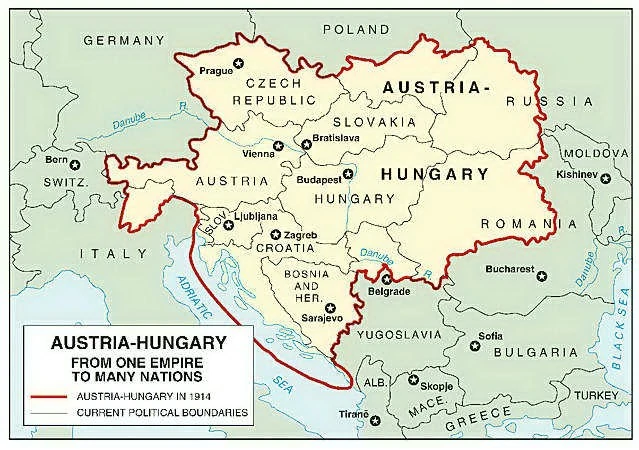
The Treaty of Windsor signed in 1917 that followed was a lot more lenient than expected. Germany gave up Alsace-Lorraine and their navy and had to pay reparations, but no attempt was made to limit the German army. Austria-Hungary collapsed before a peace treaty could be negotiated, but the attempts by German Austrians to unite with the German Empire were kiboshed by the Allies. But new nations like Czechoslovakia, Hungary, Croatia, Serbia and a multitude of other small nations sprung up from the corpse of the Hapsburg Empire.

Poor, poor Austria-Hungary. Hundred's of years of marriage and (mostly failed) wars, and all you got out of it was a footnote in an alternate history article. This time.

With peace restored, efforts to prevent another major war began in earnest. Germany was the first, announcing they were cutting down the size of their standing army, which Britain and France quickly followed suit. Russia, however, was hesitant to cut down the army, as they feared massive unemployment and unrest. Instead, Czar Nicholas II began to say that the brave Russian armies were denied their right to destroy Germany and Austria by Britain, and began to rearm and modernize with the help of the French even more than before the war. Britain, stunned at the ingratitude of the massive efforts, including taking Constantinople, that the Allies had to undertake to save Russia. A long "Cold War" began in Europe, with Britain now allying with Germany to confront their new enemies in Russia and France. Elected Prime Minister in 1925 on his war record, including the successful Gallipoli Campaign, Winston Churchill began to push for a strong force to stand up to a re-surging Russia, but his bellicose stance lead to Churchill being forced out of office by 1931 as the Great Depression struck the world.

The Middle East, on the other hand, continued to be racked by wars as the various small states, such as the Sultanate of Mesopotamia, the Kingdom of Palestine, and the Republic of Syria, fought over vast stretches of desert, especially once oil was found. The Kingdom of Turkey, after receiving Constantinople in the aftermath of the war to keep it out of Russian or British hands, began to play a middle power between the rival Great Powers, receiving massive aid in rebuilding their nation and turning it into a secular, wealthy and prosperous constitutional monarchy on the lines of Great Britain.

But what do you think? What would have happened had the Allies captured the Dardanelles and Gallipoli? Or if you have a topic or idea you would like me to talk about, please leave comments below, email me at tbguy1992@gmail.com, or tell me on Twitter @tbguy1992.