Saturday, December 10, 2016

A Sneak Peak at my NaNoWriMo Project

I'm very pleased to announce that a) this blog is now (mostly) back, after my NaNoWriMo break, then a trip to Chicago, then a bunch of other things; and b) I won NaNoWriMo with a couple days to spare! My t-shirt is in the mail already.

This year's 50,000 word story that I've been working on (and is no where near complete, sad to say) was one of the most ambitious writing projects I've undertaken, which I've come to call Project Patrician.

In this story, I've been telling the story of a small town, in the ruins of an America ruined by nuclear war in the 1980s, that, from it's founding onwards, parallels the growth and rise of the ancient Roman Republic, from Romulus to Julius Caesar.

And, most likely, doesn't end much better. Or with a salad.

Now, I haven't completed the story, but since I don't have much else to post, here is the prologue of my story to share. Enjoy!

<>    <>    <>

PROLOGUE
The history of our great town and it’s old Republic goes far back, right to the War, the one that ended the Old World. While few stories of the War have survived to the present for many reasons, such as lack of written works and stories being lost as older generations died away. While we know much of the history before the War thanks to books that survived the great global firestorm in small libraries and homes of those far from the targets, and then then years of neglect, weather and destruction after, it must also be acknowledged that what we have is just a tiny sliver of what there was before the War. While we have history books, school textbooks of science and math, copies of famous works of art, and in some cases the original documents of these great achievements in literature, sciences and art, we can only guess that, at most, maybe only 10% of human knowledge gathered before the end of the Old World has survived. This is, perhaps, a greater destruction than the fabled legend of the burning of the Great Library in long ago Ancient Egypt. This is a sad, but frequent occurrence in the line of work of a historian, that many great stories and facts of heroism and valour have been lost with time.

But what we do know, thanks to a few eye-witness accounts kept and documented, as well as the information gathered from sources from all corners of the Republic, was that the time period right before the War was a Golden Age. Technology was greatly advanced, with devices that allowed people to call someone else hundreds of miles away through cables or through the air, though I’m unsure how other people would not be able to hear them. Everyone with a cable connected to a “grid” had electricity, something that now is only for the richest of people. As we have seen in the ruins of the city called New York, they were able to construct massive, tall buildings that could house thousands of people. There self-driving wagons that could transport families or entire villages worth of people, though almost all examples have long since been scrapped and recycled. There were enormous factories that turned out all sorts of products that anybody could afford, and food and water that was safe, clean, and easy. They even had things called “computers” to store information and create new and wondrous things. Today, only a few of those computers still exist, and all of them, that I know of, have never worked.

At the time, the area that we live in now was known as the United States of America, one of the greatest nations that ever existed. They used a form of government not unlike our own, with elected leaders and representatives that met in Washington, D.C. If you go there today, some archeologists and historians have determined where many ancient monuments and symbols of the old nation existed in that city, though due to the destruction caused in the war, there is little that can be seen there. It was all lead by a man called the President of the United States, where we currently get the title for the leader of our Republic.

There were other nations all around the world that were mentioned in the books and newspapers that have survived from the Old World: England, Canada, France, China, Mexico, Brazil, Australia, India. While we know where they were thanks to Old World globes and maps, we do not know for sure exactly what they were like besides some pictures of monuments and buildings, some people dead for centuries, and some statistics and numbers that we are not one hundred percent sure what they mean. But there was another major superpower that was talked about constantly in old American books, called the Union of Soviet Socialist Republics. From what we gathered, they were a despicable, hated nation that enslaved its people, promising them equality but instead giving them nothing but hard work, miserable living conditions and lies and falsehoods dressed up as facts. Their leaders were paranoid, corrupt and power hungry, and the old United States was terrified of them, but also confident that they were superior to them. This paradox of how a powerful nation could be both afraid and superior to another nation still confuses this writer.

But this book does not mean to tell the history of the Old World, or even of the years after the War. There have been many writers and historians before me that have gone into as much detail as they could about it, and it does not seem necessary to cover all those facts once again.

However, that does not mean we can ignore it totally. Had there never been the War, it’s fair to say that the Republic we know now would never have been born. The fact that the world ended 92 years before the founding of the center of the Republic, in the year that in the old times was given as 1985 lead to the destruction of the great cities of the old United States, the Nuclear Winter that lasted until 2035, the deaths of millions of people around the world from disease, radiation, famine and violence, and eventually the birth of new towns.

Now, it’s impossible for us today to understand and appreciate how much everything has changed, how the world was rebuilt by the men of the earliest times after the War and in the early years of the Republic. In fact, almost all of the ruins of the towns and cities of the Old World have been cleared away and rebuilt in the Republic, but in some areas, like in the far south and west, past the boundaries of modern civilization, there are still the ruins of once great cities. If you someday wish to get the full experience of what it was like back in the earliest years before the founding of the Republic and the return of civilization, those are the places to go.

But there are those that were brave or foolish enough to go and take pictures of some of those towns, and some people have even sketched or used cameras to capture what the ruins of cities like old Chicago, New York, Washington, Boston, Lexington, Cincinnati, and many others looked like.

In order to understand where our city, our Republic came from, it’s important to go back to the time before our town was even founded by our great founders, Alex and George.

Monday, October 31, 2016

NaNoWriMo Break!

Hey everyone, just letting you know that I will be taking another break from the blog while I participate in the National Novel Writing Month (NaNoWriMo) challenge, to write a 50,000 word story in the month of November. Starting November 1 and through to 30, I'll be busy working on an idea I've had in mind for a long time now. Best of all: it has an Alternate History aspect to it!

I'm not going to tell anymore than that, but I hope by the end of the month I'll have a good story worth sharing with folks, and perhaps the foundation (or completed story, who knows?) for a full length novel.

But first things first, I need to write it.

If you do have any alternate history ideas in the meantime, feel free to share them in the comments or through Twitter (@tbguy1992) or send me an email at tbguy1992@gmail.com.

See you all in December!

Monday, October 24, 2016

AltHistory Scenario #26: What if Matthew Perry Failed to "Open" Japan?

Civilization VI just came out on Friday, and I've spent all my free time of the past weekend (in between watching my brother try Portal 2 for the first time) playing it, and loving every moment. Despite everyone's fears that it's cartoony art style would mean it was taking a simpler, free-to-play Mobile game approach, Civ VI has proven to be a huge step forward, much better than it's predecessor was when it was in Vanilla. Although there are a few issues I have, like religion never seeming to restore itself in it's own holy city and not being able to negotiate a peace treaty at certain times (and not explaining why I can't get a peace treaty), over all, it's a good game.

Okay, review time over. Back to Alternate history! But since it's a bit late, and I've been procrastinating all weekend, instead I'm going to try something different, and instead write a short timeline instead of the long, drawn out explanations. So tell me what you think at the end!.

Timeline:

July 1853: The arrival of Commodore Matthew Perry's American fleet to Edo, Japan, results in a firefight when Japanese sailors tried to board the USS Mississippi. The American ships proceed to bombard the ancient capital of Japan, destroying the small wooden ships in the harbour, and land a force of Marines to capture Edo Castle. The sickly Shogun, Tokugawa Ieyoshi, died of a heart attack before he could be captured. The Council of Elders assembled to rule Japan in place of Tokugawa's son, seeing the death and destruction caused by the American weapons, surrendered. Matthew Perry, realizing how backward the Japanese were, drew up a treaty that would place all of Japan under an American Protectorate, which the Emperor Kōmei was forced to sign.

Matthew Perry, seen here, on his way to meet the Emperor of Japan to discuss Phoebe's new cat and Joey's lost keys... 
September 1853: The news of what happened in Edo reaches America, and in Washington, D.C., President Millard Fillmore, Congress and the nation at large is suddenly faced with the fact that the US had just basically taken over Japan as a colony. In a huge debate in the Senate over wether the treaty should be accepted or not dragged on for weeks, until in a narrow vote, it was approved, with Northern industrialists and southern Landowners working out a deal to make Japan an "associate state" that would never be given statehood (and not upsetting the delicate balance of slave and free state) while it would be made a free economic territory for the whole US. Perry was appointed American Military Governor of the Japanese Empire, and a small force of 4,000 soldiers, including Colonel Robert E. Lee, the commandant of West Point, to establish a garrison there.

I'm going to avoid a Civil War joke here, because I General Lee don't find them that funny.

1854-1860: American businessmen began to invest in the backward nation, selling new factory equipment and tools to the populace, while pushing through major American reforms, including dismantling the Shogunate, getting rid of the Samurai class, heavy promotion of Christianity (Methodist and Baptist missionaries traveled to Japan to convert the Buddhist and Shinto populace, compulsory education and many other "western" motives and mores. This lead to resistance, especially amongst the deposed Samurai, the associates of the former Shogun, and conservative Buddhist and Shinto priests and practitioners. But many Japanese, especially in the lower class, traders, scholars and the Crown Prince Mutsuhito support the reforms, and the 4,000 strong garrison soon had 40,000 Japanese auxiliaries that helped to suppress those that want to hold Japan back to it's isolationist path. The Japanese economy begins to boom with it's close ties to the US, and the final armed uprising, in northern Honshu, is suppressed in 1860. Tensions would continue to remain, but under first Perry, and then later Lee as Governor, Americans came to respect the quickly modernizing Japanese.
Though the Americans had serious questions about Japan's taste in headwear.

1860-1870: The American colonial experiment soon begins to blossom. Places as diverse as Hawaii, Cuba, Puerto Rico, Canada, Alaska, Mexico, Western Africa (where Liberia, the home for freed slaves in the Mother Continent, had been set up in the 1820s) , and the Philippines all are soon seen as possible areas to further push "Manifest Destiny." Trading companies, with a larger US Navy to back them, begin to set up trading posts in Africa and in the Pacific. Hawaii is annexed in 1863, followed with the purchase of Alaska in 1865. A brief war between the US and Spain in 1869-70 results in Cuba, the Philippines and Puerto Rico being taken over as further Protectorates. Liberia begins to expand, as the generous provisions of the Bill of Emancipation, pushed by Representative Abraham Lincoln of Illinois in 1863, resulted in the US government basically purchasing slaves and freeing them, many electing to go back to Africa, ending slavery as painlessly as possible. This money was then often invested back into the US, with northern manufacturers selling automated machinery to the South to take up the slack. The entire US boomed, with Industry roaring ahead in the north, food, cotton and tobacco from the south being sold all over the world, and the colonies growing quickly as Immigration filled the "Homeland."

And, uh... okay, I've never actually seen the show. MOVING ALONG...

1870-1873: The American Empire hit it's first major stumbling block in the summer of 1870, when tensions between the US and the British Empire finally reached a head when an American ship owned by the Vanderbilt family was impounded in India, with a member of the crew (an immigrant from Scotland) being arrested for desertion from the army. President Schuyler Colfax, taking the affront as an insult directed from an "old and tired kingdom on a new, vigorous Republic," got Congress to declare war. In months, the first American troops began to march on the recently formed Dominion of Canada. However, the Canadian militia managed to stymie the Americans into the long and cold winter of 1870-71, and allowed British troops and the Royal Navy to sail to the Canadian's rescue. The war would last for three years, but despite efforts by the Royal Navy to interdict American trade between American and it's colonies in the Atlantic and Pacific, American troops took over all of Canada. The Treaty of New York ceded all British holdings in British North America, who then turned east, to India, Egypt and for allies in Europe.

Though, tbh... it's not exactly hard to find redcoats in white snow...
1873-1900: The next quarter century was America's Golden Age: with colonies around the world and one of the quickest growing populations and economies in the world, and with an entire continent to itself (Mexico was made a protectorate in 1881 after yet another civil war and military coup made the nation too unstable). However, the quick expansion and the military to protect it, funded mostly through tariffs, was proving too much. Income tax was introduced in 1881 to prevent the nation from going into default, but it was hugely unpopular measure. Questions also began to rise about the nature of American imperialism: was America going to eventually liberate the countries they took over, and make them independent? Or were they to remain in a permanent limbo between full statehood and full independence? And what was the boundary to make it clear? In some cases, like Canada, it was easy: once enough white men lived in an area, it could be entered as a state. This lead the America adopting the 60 star flag by 1900 with the introduction of Saskatchewan as a state. But in areas like Japan, Liberia and Cuba, the question was more fraught: racism and economic interests formed a powerful bulwark to preventing those nations from going their own way. It was only a matter of time before something gave.

And then the whole world will be flooded with all the weird Japanese memes

1905-1910: That something was the Great War of 1905-1910. Europe found itself at war as tensions between France and Germany finally resulted in war. Britain, coming to the aid of it's ally Germany, put up a blockade against France. France, reeling from the double blow of German invasion and British blockade, was only helped by Russia, who's ineffectual army was soon destroyed by the German and Austro-Hungarian forces it opposed. But the Royal Navy sank several American ships that continued to trade with France, and soon President Theodore Roosevelt was pushing his nation to fight the British once again. The US and Royal Navies soon began a running battle across the ocean, while British troops invaded American colonies in Africa and Asia, and vice-versa. However, the steady supply of troops and resources prevented France from loosing the war, while Russia descended into a brutal three war civil war by 1908, with Republicans, Communists and the Czar's Loyalists all fighting for the nation, and the outside world unsure of who to help or hinder. But the war in France ended in a stalemate: British and German forces were not enough to overcome French and American troops, but the US and France were not in any shape to fight back. So the Treaty of Brussels ended the war with all four major powers (and Austria-Hungary, Ottoman Turkey and Italy as minor players) dividing the world between them.

Just draw the lines where you want them. That's basically what the Europeans did.

1910-1929: But the world of Empires, however, soon began to strain. The colonies of the Europeans were underdeveloped and slowly bleeding the homelands white from the cost in money, men and morals, while the Americans were struggling to deal with the high costs of the war with their increasingly resistant populations. American Exceptionalism that drove the empire was now tearing it apart: The belief that because America had built their nations up not just for the betterment of the homeland but for the people that lived there blinded them to the fact that they were just like the American colonies in the mid 1700s, seeking to break free from a disinterested homeland that only saw them as a source of income and burdens of defence. And in 1929, three years after the New York and London Stock Exchanges crashed, destroying the global economy, the American colonies in Japan, Liberia, Mexico, the Philippines and Cuba all rose up, and began to fight the American oppressors.

I've picked on Japan enough. Time to go to another Asian country and make a silly reference about them!

1929-1935: The American Colonial Wars, also known as the Independence Wars and the Second American Revolution rocked the nation and it's Empire. Japan, the oldest and most developed of the territories held by the US, was the first to rise up, under the leadership of Japanese Nationalists like
Isoroku Yamamoto and Hideki Tojo, followed a few months later by the Philippines. Cuba, which was poor and even still held slavery in several places, had a violent insurrection of the black populace that was brutally put down by the Cuban National Guard, only for it to constantly flare up again and again, leading to a long running guerrilla war. Mexico, after a few precious decades of peace, demanded freedom again (and a long running fight between Liberals and Conservatives there would cause even more damage). Canada and Liberia also had their moments of resistance, but except in a few isolated instances in Quebec and in the deplorable Indian Reservations, it was mostly peaceful, with constant demonstrations and demands for rights. President Herbert Hoover, elected in 1928 to try to solve the Great Depression, was now faced with a multi-front Colonial War which he was increasingly incapable of handling. More and more soldiers were sent to Japan, Cuba, the Philippines and elsewhere, and the casualty lists grew longer and longer. Taxes at home went up to pay for it all, which only pushed the US even deeper into debt.

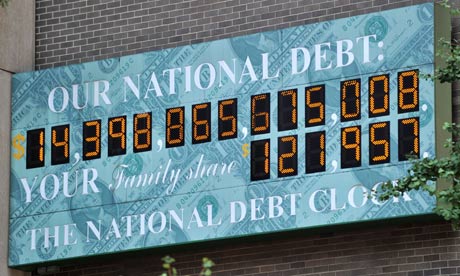
Because there is no American political crisis like one over spending money, not raising taxes to cover it, then borrowing it, and then engineering a crisis because of an arbitrary borrowing limit!


1932: Bombings, assassinations, blackmail and gang wars at home by blacks, Japanese-Americans, Mexicans, the Mafia and other groups soon ended with the Assassination of Herbert Hoover in early 1932, the first American president so killed in history. Vice-President Charles Curtis, now the President, declared Martial Law, suspending the US Constitution for a year (and later continuously extended as the crisis continued), imposing censorship which ended up shutting down many newspapers and strangling the radio and motion pictures in it's infancy, and ordering the army, the FBI, the Secret Service and other police forces to round up all suspected revolutionaries, deporting many to hastily constructed prison camps in the wilds and unpopulated areas of Ontario, Dakota, Manitoba, Alabama, Louisiana, Nevada and Alberta. This only inflamed Americans at home, and soon Communists, Fascists, Canadian and Quebecois Nationalists, and "Minutemen" democratic patriots were fighting at home. The American Civil War had begun.

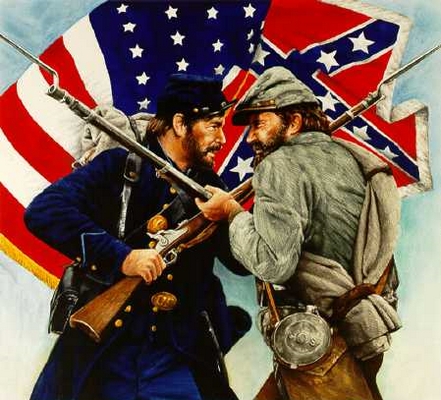
From this picture, you'd think the civil war was over if the flag looks better in stripes or in a cross...

1932-1937: Five years of bloody war left the US a wreck. It's Colonies one by one had gained their freedom (Japan in 1933, Liberia in 1934, Mexico in 1935), and the Canadian states, along with Dakota, Montana, Michigan, New England, Oregon and Washington had all seceded and formed the Union of North American States. Communists in Pennsylvania, New York, Illinois, Ohio, New Jersey and Wisconsin had joined together and formed the People's Republic of America, lynching corrupt bankers and industrialists and attempted to build a true communist society compared to the totalitarian hellhole that was Stalin's Soviet Union. In the South, lead by Southern plantation owners, many of whom had land and prestige, but little money, and white-power supremacists that still resented the Emancipation Bill sixty some years before, established a Fascist Confederation of Southern States that attempted to undo decades of as of yet unfinished civil rights and virtually re-enslave African Americans. Texas went their own way, along with Arizona, New Mexico and Oklahoma. The US Government had fled from Washington, D.C. and set up a temporary capital in San Francisco, with California and other western states now under brutal military rule by the remnant of the old United States. By this time, Liberia had established itself as a mostly democratic state that would, in the future, provide a blueprint for the colonies of Africa when they managed to leave their European masters.

Nature, however, is still there. And terrifying. 


But what do you think? What would have happened had the US decided to go on a colonizing spree? Or if you have a topic or idea you would like me to talk about, please leave comments below, email me at tbguy1992@gmail.com, or tell me on Twitter @tbguy1992.

Monday, October 17, 2016

Editorial: An American Westminster Democracy?

With all the hoopla of the current election in the United States, and all the talk of primaries, conventions, the Electoral College, polls, scandals, etc. etc., it can all seem just a little bit overwhelming.

Mostly because of him...
American democracy has a lot going for it, but it's a hopelessly outdated system, with only minor tweaks since it was put together by the Founding Fathers in 1787. Take the Electoral College: it was designed to make sure the "mob" didn't dominate the country, with men above the political fray making the deciding vote on who would be President. The Senate was to be elected by the different states, and only the House of Representatives was elected by the citizens at large (and back then, only white men with some property). But over the years, eventually almost every office in the US, from President to Judges to State Governors to Dog Catchers were elected, though I think jobs like judges should be kept above the partisan fray. The checks and balances of the system are also something to be proud of, until of course it bogs down when two ideological opposites are in charge of the Executive and Legislative branch.

But the problems with the US system is still immense. The Electoral College is unfair for everyone: Smaller states have a larger vote than bigger states, but at the same time only a few states, like Florida and Ohio, can determine who will win the Presidency. Federal electoral districts are drawn up by the states, and in many states they are gerrymandered to give the party a better chance in Washington. It's more or less the way for successful candidates being able to choose their voters, and not the other way around.

I present to you... the Illinois Fourth District. Do I need to explain why this is stupid?
So why don't we just scrap it? Why not try a government system like in the United Kingdom and Canada? Of course, history wise we know it wasn't going to be even considered by the new US, considering what Parliament in far-off London did to piss off the colonialists, and I'll be the first to admit there are some issues with this form of government. But let's do a thought experiment, and see how the US would look if it had a system of government similar to the Westminster parliamentary system?

Well first of all, everything you know about US elections will have to be thrown out the window. Their will be a Prime Minister who is the leader of the government, and is usually the leader of the largest party (or coalition of parties) in a representative body, which can still be the House of Representatives in this version. The President can still be head of state, and he can be powerful (like in France) or weak (in Germany) as see fit. My guess, in order to maintain some checks and balances, the President would have a lot of power in this alternate American system. I'd give him the power to call elections for the House of Representatives (either with or without the "advice" of the PM), veto laws, and appoint judges and other executive positions, barring confirmation from the Senate. How the President is selected can be left up to debate. Maybe this is where the Electoral College would come in, but I'd be more willing to just have him either elected directly by the people, or selected by a joint session of Parliament/Congress. The Senate, if it would be similar to the UK or Canada, would have appointed members: say they are chosen by the State Legislators to sit until they retire, are removed, or died. In Canada, the mandatory retirement age is 75, so something similar could be seen here.

As soon as you reach sixty, you not only get the Seniors Bonus discounts at the Senate Restaurant, you also can apply for a lift chair in the chamber!

The Prime Minister, however, will have a huge amount of power, being the leader of the largest party in the House of Representatives. Now, the way the House would be divided up will be similar to OTL, but with one huge change: the electoral districts will be set by an independent, non-partisan committee. The UK's districts had been before determined by the monarch when Parliament and the House of Commons was being set up, but in many cases they didn't change. It got to the point in the early 1800s that many of the largest growing industrial towns like Manchester and Birmingham had no representation, while agricultural areas that had only a tiny population, or sometimes no population at all (Old Sarum, for instance, had only seven voters), would still elect two (TWO!) Members to Parliament. These "Rotten boroughs" were eventually done away with in 1832, though it wouldn't be until 1944 that non-partisan electoral boundary committees were set up to determine the boundaries. The US, in this Alternate History, might be sooner than that.

Elections will also be interesting. In the case of the federal government, they could serve a term as long as 4 or 5 years before mandatory elections, as long as the Prime Minister, and by extension his party, maintains control. Now, elections can be called sooner: In the event that the largest party doesn't have an overwhelming majority, a vote of non-confidence, say the opposition uniting to defeat the PM's budget or a major platform policy, can be enough to force the PM to ask the President to dissolve the House and call elections. For example, in Canada, between 2000 and 2015, we had six elections (2000, 2004, 2006, 2008, 2011, 2015), of which only three resulted in a "majority" government, or one where one party had more than half the seats (2000, 2011, 2015).

Justin Trudeau's hair also won a seat in a Montreal area riding, further bolstering the Liberal majority.
So, how would this version of the House of Representatives be made up? First, we'll say there are 435 seats, like OTL, and that they are evenly distributed by a non-partisan body like in Canada and the UK. If we use the numbers from the 2012 election (as it would be more representative of the US population, as turnouts are lower in "midterm" election IRL, and would more accurately determine the US's political view point at the time), the Democrats would have more seats, but only 212 seats. The Republicans, with 207 seats, would be the opposition. The other 16 would be held by third parties...

BUT WAIT! Unless the US decided to also change to something other than a first past the post system for elections, then it's not a guarantee that the Democrats would actually have that many seats, or that third parties would even gain a seat (which, unfortunately, is a problem still with the US's two party system). Possibly they might have more than that. After all, say there are three districts, each with 100,000 voters. In one district, 80% of the voters chose the Democrat, so that seat went to the Democrat. In District Two, 80% of the Vote went to the Democrat. But say in District three, the Democrat got 45% of the vote, the Republican 40%, and a Libertarian candidate the other 15%. Even though the Democrat didn't get a full 50%+1, he still won the election. This is just as true in the current system as it would be in the Westminster Democracy.

As with any election, you need three things... A map, different coloured pens, and numbers to decide everything!


However, one thing about the Westminster Democracy: third parties do have a much easier time in getting seats, especially regional parties. In the UK, the Scottish National Party holds 54 Seats, and with the other third parties and independents, there are 89 seats that are not held by the Conservatives of Labour party in a 650 member House of Commons. Similar in Canada: The Liberal Party holds 184 seats, the Conservatives 99, the New Democratic Party 44, the Bloc Quebecois at 2, and the Green Party at 1. But the Liberal Party, despite winning so many seats, only actually received 39.5% of the vote. So in the alternate US system, third parties, especially regional parties, would have a much easier time getting seats. For all we know, a "New Confederacy" Party could have swept the Southern States, or split the vote with another party to let a different party win.

"See, if only we didn't vote for the 'Haven't Got a Chance in Hell' Party, we could have prevented the Conservatives from winning!"

So would this system be better? In some ways, such as allowing third parties a chance to get more seats, yes. It would also make the House of Representatives more powerful in the Federal Government, as it's the body most directly in turn with the average citizen, with a President that has more limited powers and a senate composed mostly of appointees. In breaking deadlocks, perhaps. After all, if the party in power doesn't have a commanding majority, or a formal coalition, then it could be taken down at any moment, and a new election being held. But in more accurately representing the vote, that would be a no. In some cases, with more third parties, it could be worse than it currently is with the gerrymandering in the US system.

Now I'm not saying the US should use this system. But I think the US system needs a complete overhaul. It was established when a man on a horse was the fasting transportation possible, and concerns about full-fledged democracy was a major concern to the framers of the Constitution. But now with cars, cell phones, the Internet and cable news networks, the old fashioned system is showing it's strains, and will eventually completely fall apart.

Unless that is actually what America wants to do...


But what do you think? What would the United States be like if it took the political system Ye Old Englande? Or if you have a topic or idea you would like me to talk about, please leave comments below, email me at tbguy1992@gmail.com, or tell me on Twitter @tbguy1992.