Friday, August 14, 2015

Real History #2: The Winnipeg Grenadiers and the Battle of Hong Kong

Tucked into a corner of the Military Room of the museum I've been working at this summer in Melita, Manitoba is a World War Two uniform that, at first glance, is very similar to the other ones that had been donated or loaned to the over the decades. The khaki uniform by itself is unremarkable, but when you look at the three ribbons for medals and the patches on the sleeves, another story is told. Unfortunately, this story is of war, terror and unspeakable atrocities that the wearer would have gone through. For the name of the unit, in white letters on red is "WINNIPEG GRENADIERS," and below that, a very "Oriental" facsimile of the letters HK, standing for Hong Kong.

It's amazing all the things you will find in small town museums. 

The Grenadiers was first established in 1908 as the 100th Regiment, with the Headquarters in Morden and the eight companies in different towns throughout southern Manitoba. In 1910 the entire regiment was moved and based in Winnipeg, and was renamed the 100th Winnipeg Grenadiers. In 1920, after World War One, the regiment was finally renamed as the Winnipeg Grenadiers. While the regiment itself didn’t serve in World War One due to the establishment of separate battalions for the Canadian Expeditionary Force, the Grenadiers were allowed to “perpetuate,” or preserve the battle honors and traditions of three battalions from the CEF: the 11th Battalion, the 78th Battalion (Winnipeg Grenadiers) and the 100th Battalion (Winnipeg Grenadiers). In 1936, the 10th Machine Gun Brigade, CMGC (Canadian Machine Gun Corps) was amalgamated with The Winnipeg Grenadiers, and now the unit was officially The Winnipeg Grenadiers (MG). Other units have been formed and merged and broken away over the years, so to make it easier, here's a picture. If you can't read it, here's the link

Told you it was complicated...

When World War Two broke out in September 1939, The Winnipeg Grenadiers was activated for war duty and was renamed First Battalion, The Winnipeg Grenadiers. A second Battalion was set up to serve as a reserve force and remained in Winnipeg for the duration of the war. The First Battalion was sent to Jamaica and Bermuda for garrison duty from May 1940 to October 1941. But in autumn of 1941, the Canadian government chose the Winnipeg Grenadiers as part of “C Force,” a small unit of Canadian soldiers offered to Winston Churchill, Prime Minister of the United Kingdom and one of the most interesting people ever, for the defense of Hong Kong. C Force also included the Royal Rifles of Canada, originally from Quebec, though they had only served in garrison duty in Canada. In all, 1,977 soldiers and headquarters personal under the commander of Brigadier John K. Lawson were sent to Hong Kong on two ships, the troopship Awatea and armored merchant cruiser Prince Robert. With other British, Indian and local Chinese troops, over 14,000 soldiers were now in place to defend Hong Kong.
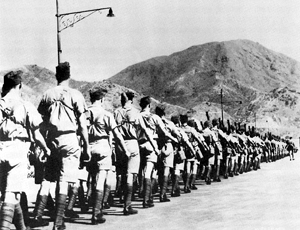
Everything will be fine. Right guys?

Hong Kong had been a British colony since 1841, captured from the moribund Qing Empire in the First Opium War, and served as an important trading base with China and Asia for decades. However, with the end of an alliance between the United Kingdom and the Empire of Japan in the 1920s, British military officials realized that Hong Kong would be nearly impossible to hold in the face of Japanese attack. These fears only increased after 1937 with the start of the Japanese invasion of Mainland China, which lead to the surrounding of Hong Kong.

British Hong Kong: For all your "Overthrowing Empires with a Highly Addictive Drug" needs!
When war broke out in Europe in 1939, Winston Churchill and his military advisors decided to reduce the size of the garrison of Hong Kong to a “symbolic” size. But in September 1941, that decision was reversed. It was believed that a fortification of the colony serving as both a possible deterrent to Japanese aggression and reassurance to Nationalist China leader Chiang Kai-shek that Britain would support them.

On December 8, 1941, those hopes proved false. Eight hours after the attack on Pearl Harbor in Hawaii (which happened on December 7, 1941, as many people I'm sure are going to tell me. However, both events were on opposite sides of the International Date Line, hence the differences in dates) 52,000 men of the Japanese Twenty-Third Army invaded Hong Kong with no warning, catching the British forces unprepared. With only five planes (the closest squadron being over 2000 kilometres away) and three destroyers, two of which were soon sent to Singapore. The British were outnumbered 4 to 1, and the Japanese forces had recent combat experience fighting in China, while most of the British, Indian and Canadian troops were garrison units with little or no combat experience.

The Battle for Hong Kong lasted 17 days, during which time the Allied forces were forced from the small enclave on the mainland to the island of Hong Kong itself, and the defense divided into two brigades to support the other. The Japanese landing on the island on December 18 was fiercely fought, and the West Brigade under Canadian Brigadier Lawson were overrun, with Lawson himself losing his life, the most senior Canadian officer in World War Two to have died in battle. By Christmas Day, 1941, the remaining British and Commonwealth forces surrendered. Of the 14,000 troops, 2,113 were killed or missing, 2,300 wounded, and 10,000 were captured by the Japanese. 

Because I can't describe everything that happened... here's a map.

Only 2000 Japanese soldiers were killed, with 6,000 wounded. One of those killed was Company Sergeant-Major John Robert Osborn, who was awarded the Victoria Cross, the highest decoration that can be awarded in the British Commonwealth, for heroism during the battle. When a grenade was thrown into the house he and several soldiers were fighting from, Sergeant-Major Osborn shouted to his comrades to stay down, and he jumped on the grenade, sacrificing himself to save many others.

Those that were captured faced horrific conditions and treatment at the hand of the Japanese, who saw the prisoners of war as “subhuman” for not fighting to the death, and therefore having lost all respect and rights. They were forced marched and kept in unsanitary, overcrowded conditions for years. Soldiers were beaten, starved and even killed at the hands of the Japanese soldiers. Japanese soldiers also massacred hundreds of soldiers and civilians during the battle, and the populace was subjected to rape, violence, starvation and oppression until the surrender of Japan in September 1945. Fortunately, the man who wore the uniform donated to the Museum lived to see his home in rural Manitoba after the war.
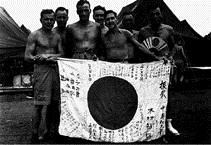
I really have nothing funny I can say about the treatment the POW's received... so here's a picture of when they were liberated 
The 1st Battalion, Winnipeg Grenadiers, was re-established in 1942 and served in Canada as part of the defense of Canada, before being sent to Alaska and later England as a training unit for the rest of the war. After the war The Winnipeg Grenadiers served as part of the active army until February 28, 1965, when it was placed on the “Supplementary Order of Battle,” meaning that it is virtually disbanded, with no personal serving under that regiment. However, should the need arise, the regiment can be reformed and “…it will take its old place in the order of precedence and its colors, traditions, and battle honors will remain as if there had been no interruption of service.” So maybe someday The Winnipeg Grenadiers, the first Canadian military unit to see fighting in World War Two, will be established again.


Tuesday, August 11, 2015

AltHistory Scenario #2: Andrew Jackson is Never President of the United States

Andrew Jackson (1767-1845) provides the start of a very interesting era in the early history of the United States, one that eclipsed the early fight between Federalists and “Jeffersonian Democracy” of the size and role of government to a broader, more populist idea pushed by Andrew Jackson. Elected in 1828 and again in 1832, his influence was felt in America for decades after, right up until the Civil War. Coming from an area that hadn’t even been properly surveyed in modern North and South Carolina, his backwoods upbringing, service in both the Revolutionary War and the War of 1812, abilities as a lawyer, infamous temper and resort to duelling to avenge any attack on his honor makes him one of the most interesting personalities to occupy the White House until at least Teddy Roosevelt. His policies, especially in the forced removal of American Indians, have since fallen under scrutiny and are debated today. Yet, he’s still on the $20 bill.

And what did TR get? A mountain with his face carved in it?

So what if Jackson never became President? How big of a hole would he leave in American history? Well, here’s a possible scenario.

Point of Divergence:

The POD is something I’ve had to think a lot about. While originally the POD I wanted to set up was if he was elected in 1828 as in our history, but had been assassinated in office, possibly in 1835, that wouldn’t result in a major change in history as most of the major reforms and policies would have already been enacted. The Election of 1828 is also a possible POD, where he lost to John Qunicy Adams (who Jackson believed had stolen the four way tie of the 1824 Election from him), but I think this is unlikely as well. Therefore, let’s just say that either in the Battle of New Orleans that established his fame or in a duelling incident after, that he was killed, removing him from history.

Jackson, get yourself down from there! You'll be shot by those damned Redcoats!

Consequences:

There are four major things I would like to focus on here, if Jackson was never president, and his populist policies that founded the modern Democratic Party were never enacted. This is not to say that a future President could have eventually done many of the things that Jackson did, but for the purposes of this article, we are just looking at if the policies that Jackson put in place were never implemented.

First, and the most controversial of all, was the Indian Removal Act that lead to the displacement and death of thousands during the "Trail of Tears" and the Seminole War in southern Florida that stretched into the Presidency of Jackson’s successor, Martin Van Buren. In this timeline, without this policy, the Indian’s that remained in the Deep south in places like Georgia, Alabama, Mississippi and Florida would remain where they are. For decades, as European and American settlement advanced into their traditional lands, groups like the Cherokee, Choctaw, Muscogee (Creek), Chickasaw and Seminole had adapted, adopting the settler’s culture and earning the nickname the “Five Civilized Tribes.”

And then they would have ended up in... Oklahoma. 

Since these tribes remained, they would be able to integrate into the society of the South, a policy that later presidents could use with the more “wild” tribes of the West and North. While I wouldn’t go far as to say that the relations between White and Native American’s would be perfect, I’d think without major antagonism, such as their forced removal from ancient homelands, maybe the Indian Wars, and battles like Little Bighorn and Wounded Knee would never occur. Maybe a bit wishful thinking, but I don’t see how attacks like real history could have happened without the Indian Removal Acts.

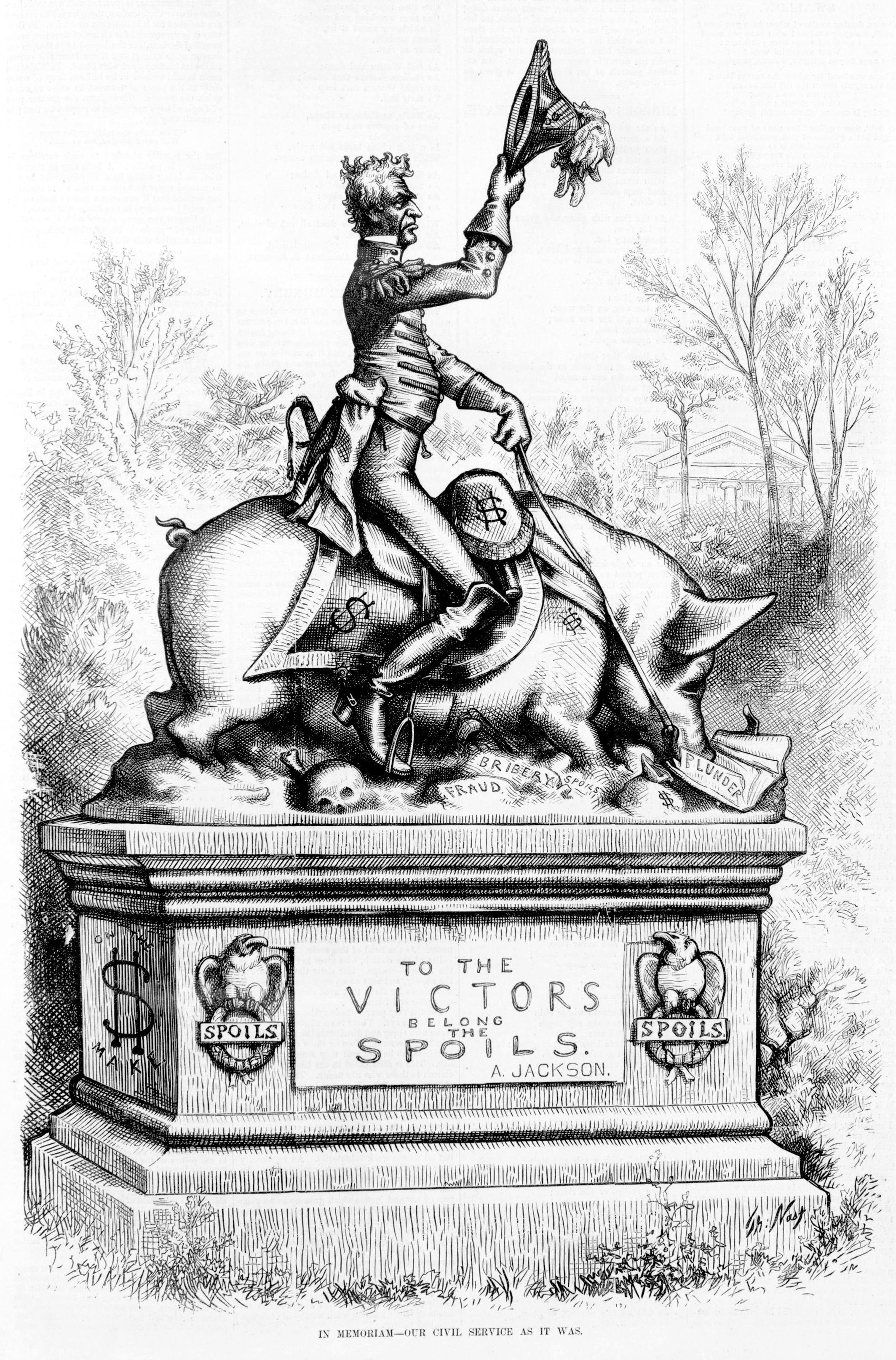
The second major thing of Jackson’s presidency was to the civil service and bureaucracy, the rotation and “spoils” system. To put it simply, the rotation system was to prevent offices from becoming hereditary, solely for elites, passed down from father to son like titles and offices in European monarchies. This was to make it easier to prevent corruption and encourage more outsiders, especially those without a good education or background to assume office.
Man, Thomas Nast was mean...

However, the second part, the spoils system, created the corruption Jackson was trying to eliminate. When a new president comes to power, with the spoils system he can remove those who follows his opponent, while rewarding his loyalists with powerful, high paying federal appointments. While the really bad cases of the spoils system didn’t come to light until after Jackson’s term, if the spoils system was never brought in, then maybe a bigger disconnect between the wealthy, educated elites and the average farmer and worker would widen and grow. However, I feel that eventually a “Spoils System” of government would be firmly entrenched until major, full scale education and civil service reform was performed later in the 19th and 20th centuries are undertaken.

Third, the economy. Jackson, for all the things he did, basically destroyed the US economy with a few measures he believed was to eliminate the power of wealthy bankers. First, he vetoed the charter of the Second Bank of the United States, which was a private bank that served more or less as a central bank to the US (a role that the Federal Reserve plays today), and was authorized to hold the financial accounts of the government and print paper money. Jackson, who disliked the power of the President of the Second Bank, Nicholas Biddle, fought to dissolve the bank. By first withdrawing all of the government’s reserves into state banks, who now basically had the license to print money, it severally impacted the ability of the Second Bank to actually function, and it finally collapsed in 1841. Without a larger bank to control the smaller banks, speculation ran rampant and inflation skyrocketed, especially in land as western expansion continued, fuelled partially by the suddenly available land from the Indian Removals. In one of his last acts of office, Jackson signed an executive order known as the Specie Circular where all federal lands had to be paid for in gold or silver, nominally to actually slow down the speculation.

Then again, Nicholas Biddle totally looks like a "fat cat," so really, can you blame Jackson?


Since the banks that printed the money didn’t have enough gold and silver to trade, many of them collapsed, sparking the Depression of 1837 that lasted for five years, and doomed Martin Van Buren’s presidency. If the Second Bank of the United States lasted longer, maybe eventually being made part of the government, I feel that the US would have had a more stable banking system. The vicious cycle of boom and bust that would define the history of the US until at least 1914 when the Federal Reserve was created, the US economy would have seen more steady, if maybe slower, growth than was the case in our history. Recession and Depression would still happen, but I think with a stronger central bank to control the money supply, the effects wouldn’t be as harsh.

Finally, we have the Nullification Crisis. In 1828, Congress passed tariffs that severely effected states like South Carolina and the south with more expensive Northern machinery and products, with a fall of cotton and other agriculture prices. This “Tariff of Abominations” as it was called, gave South Carolina the chance to try to “nullify” a federal law that the state felt was against it’s interested, and even raised the possibility of succession over 30 years before the Civil War. Jackson, though sympathetic to the plight of the South, responded by threatening to personally lead an army into South Carolina to enforce federal law, saying that the central government needed to be strong, even if it went against what states believed was in their interests. This became a huge point, one that would be brought up later in the Civil War, and still used today, of what rights the states have in comparison to the federal government.

For example: the right for states to have really boring flags... I'm looking at you, Montana!

This could be the most important effect in American history if Jackson was not in office. Without such a forceful defender of the Union, and if South Carolina successfully nullified the Tariff, what would have the rest of the states done had another, much bigger states right issue came along, such as slavery? I have a feeling that in this case, the US would have split into at least two, if not more countries, and possibly without an effort by a weaker, less powerful federal government to maintain the union. While there wouldn’t be a Civil War, these new nations, driven by ideology and economics, would remain rivals, and possibly come to blows, making it even bloodier.

Conclusion:

Andrew Jackson was an important President of the US for a lot of reasons. He was one of the first populist presidents, one that did things that he thought would benefit the common man, even though many of those things, such as the Indian Removal Act and the destruction of the Second Bank of the United States caused more harm than good in the long run. But he was strong supporter of the union, a nation indivisible. This belief would run all the way to Abraham Lincoln and today, even if Jackson and Lincoln were in opposite parties. If Jackson was never President, I don’t know how Lincoln could have held the United States together in a Civil War by adamantly standing up for the union if Jackson hadn't done it as forcefully. This is to say, even if the Union survived long enough with states nullifying Washington’s policies or simply seceding from the Union.

I'm sure these guys would have liked that...


I feel that in the long run, if Jackson wasn’t President, the US could be better in some areas, namely in relations with Native American’s and the economy, but worse in others, in a lack of a strong union. Issues like the spoils system would come up eventually anyway; States rights and nullification could have been handled, but not in such a forceful way; the Second Bank may have lasted longer; and the policy of “don’t do anything” about the Native Americans could have lasted until they were more or less like the rest of their neighbors, just not of the same cultural background.

I think this scenario where Andrew Jackson was never President is also a good time to lay out my major, overriding personal idea when it comes to Alternate History: if you change something, I don't necessarily think that it's always a case where the world is better or worse because of these changes, just... different. In general, I feel that when you draw up these scenarios, maybe the winners of our history are now the losers, but that doesn't always mean that now everything is going to be remarkably better or disastrously worse. Well, in most cases: plagues and nuclear wars pretty much ensure making everything a lot worse for a long time. But in general, I feel changes like removing Jackson as seventh President of the US may change some things, like relations with Native Americans, for the better, but also change other things, such as the possible survival of the United States for the worse. Are the equal? Depends on how you look at it. All I know is that history without this event (and the many, many other scenarios I will be talking about for the next who knows how long) is going to be different.

Friday, August 7, 2015

Real History #1: CONELRAD, or the Last Thing You May Haver Ever Heard in the 50s

On Tuesday, for the inaugural article for this blog, I've outlined a scenario where the USSR never developed an atomic bomb. Part of the reason for that article was this one, which I wrote on the behalf of a local museum for the small town weekly newspaper. That is part of the reason that I started this blog in the first place!

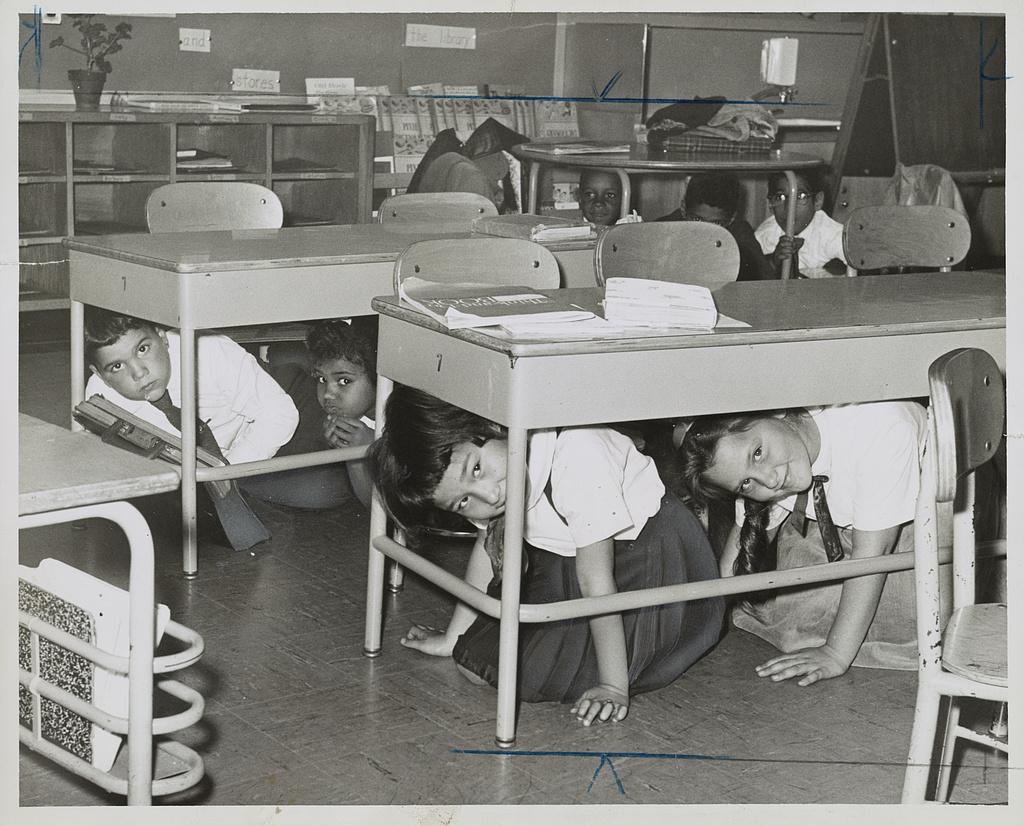
For those to young to remember, the Cold War was a time of mistrustful peace, ideological conflict and the overhanging fear that at any moment, nuclear Armageddon could be unleashed, resulting in the destruction of civilization, if not all of humanity, in a blink of an eye. If you ask those who grew up in the 1950s and 1960s, they can still tell you about the “Duck and Cover” drills, where they would duck under their school desks when the sirens went off to warn of air raids. This wasn’t necessarily to protect you from the fallout, but the burns and falling debris. So, no, school desks won’t protect you from radioactive fallout!
Don't worry kids! You'll be fine!
The period between 1945 and 1991 was dominated by the political, economic and military conflict between the nations allied with the United States of America and the Union of Soviet Socialist Republics, known better as the USSR. The US, Canada, Western Europe (known as NATO) and dozens of other nations around the world were in favor of capitalism, while the “Warsaw Pact” of the Soviet Union and the states of Eastern Europe, China and Cuba pushed Communism as not only a viable alternative, but the future for the whole world.

At first, only the US had access to nuclear weapons technology, but by 1949 the USSR had it’s own nuclear weapon, partially thanks to spies and informants in the American and British Manhattan Project that passed information to the Soviets, as I mentioned early this week. Fear and paranoia in America about Soviet spies lead to the “Red Scare,” lead by Senator Joe McCarthy and the House Un-American Activities Committee, but more directly it lead to panic that the Soviet Union could now bomb the US. In 1951, President Harry Truman therefore established a new system to warn the American people in the event of a nuclear war, CONELRAD.

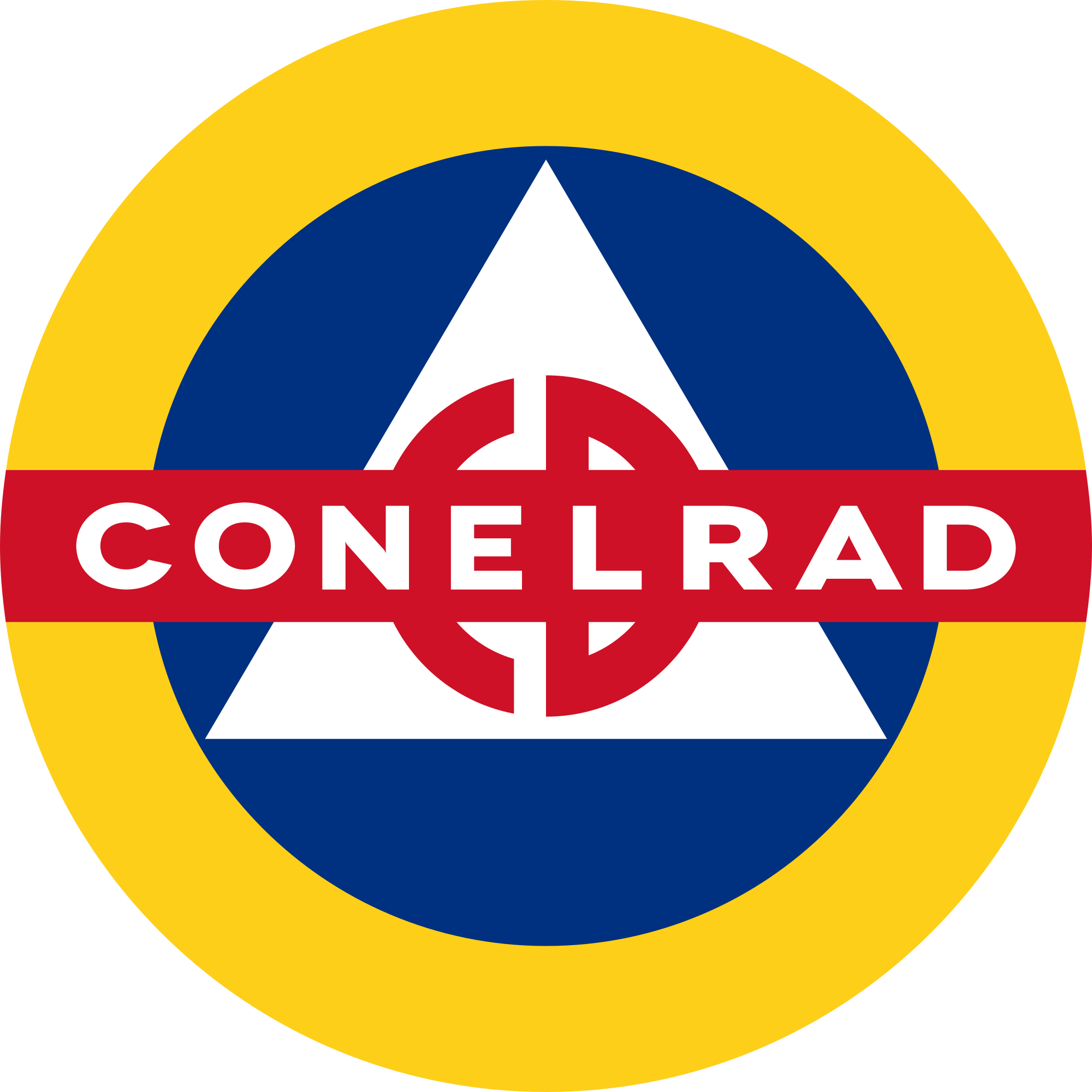
Pretty creative logo, huh?

Before 1951, there was no system in the US, much less Canada, to warn the American people over radios or the new medium of television. While radio stations did interrupt broadcasting during the attack on Pearl Harbor in December 1941 and the first successful tornado alert was sent over the radio in 1948, there was no unified, national system.

CONELRAD was the first such system. Standing for CONtrol of Electromagnetic RADiation, it had a two step goal: to warn the American people, and to throw off the nuclear armed Soviet Bombers sent to attack American cities. In the event of a nuclear attack, all TV and FM radio stations would go off the air, and the few stations left on the air would broadcast at 640 or 1240 kHz for a few minutes then shut off, then another station would take over for a few minutes before it shut off and another station would take it’s place. This was designed to confuse Soviet bombers that might be using radio frequency detection equipment to find American cities, apparently in the belief that USSR pilots couldn’t find the big, sprawling cities and military bases that were their targets! In order to alert stations in the “Key Station System,” an ad-hoc approach of shutting down and turning on the transmitter of the main stations several times before sending out an ear piercing shriek actually lead to failures and false warnings when transmitters, not designed to be rapidly turned on and off, failed to restart.

Posters like this were a major part of the information campaign issued by the Federal Civil Defense Administration of the US during the early Cold War.
Between 1953 and 1963, all radios made in the US had the symbol of Civil Defense (a triangle inside a circle, often with a CD) marked at 640 and 1240 AM. When the alert was issued, everyone was to turn to one of these stations to hear pre-recorded instructions and information from the Board of Civil Defense about how to survive in a nuclear exchange: do not go outside in fallout, turn off gas, save water and ration your food were the primary messages. When many of the messages were later de-classified, scientists discovered that the information about fallout and nuclear blasts provided in the broadcasts were almost totally wrong, which raises questions about exactly how many people would have survived following CONELRAD’s instructions. And as with all technology and human error, we would never know if CONELRAD would have fully functioned in a nuclear war, or if people would listen to the messages that were sent, as most asked that parent's not worry to find their kids if they were in school, stay off phone lines for emergency personal only, and, if there was not enough time, not to evacuate and clog up the roads. All of these things would have been counter to instincts would suggest. I'm unsure if CONELRAD, even if it worked flawlessly to alert people, would have saved many lives.

This is the radio that I found at the museum I was working at this summer that sparked this article
Here you can see the "CD" and triangle that marked where to turn the radio to in the event of a nuclear war.


Thankfully, CONELRAD, nor its successors have been used to warn the American people of a nuclear war. CONELRAD was shut down in 1963 after the Cuban Missile Crisis when intercontinental ballistic missiles (ICBMs) were seen as the bigger threat than Soviet bombers, so trying to disrupt radio path-finding equipment was not necessary, and the Emergency Broadcast System (EBS) took it’s place. Today the Emergency Alert System (EAS), which replaced the EBS in 1997, is used to warn of natural and manmade disasters besides its original Cold War goal of nuclear war. The EBS especially became a major facet of the culture of the Cold War, being used in movies like The Day After and comedy, and still used today, as the Winnipeg Free Press mocked when the 2015 General Election was called in Canada:


And it was only in 2015 when Canada established it’s own public emergency system, Alert Ready, which allows Environment Canada and provincial authorities to issue alerts to public safety quickly, with the goal to save lives in emergency situations. While the first few times it had been activated for tornado warnings, the computerized voice garbled town names, and in some cases came on after the tornado had already touched the ground or had left. 

If you want to scare yourself, or rather would like to hear what could have happened, here are two links to simulated or pre-recorded messages that would have occurred in the event CONELRAD or the more modern EAS had been activated:

A prerecorded message by Dick Chapman and Minnesota Governor Elmer Andersen

A simulated CONELRAD activation in the Spring of 1962. Well done voice acting and the Password Game was the one that would have been shown on the date!

A modern revision if the Emergency Alert System is activated in the event of a nuclear war in New York