Tuesday, October 27, 2015

AltHistory Scenario #13: What if Nazi Germany Didn't Attack the USSR?

Well, about time I did this. An alternate history focused on something that happened in World War Two! You'd have thought I would have done this already. Then again, I was going to try to do theme months, but that will be later.

Besides, who doesn't love a scenario set in one of the longest, bloodiest and most widespread wars in history? So let's focus on two of the biggest powers involved, the Third Reich of Adolf Hitler and the Worker's Paradise that was the Soviet Union.
Who knew the gulags and Five Year Plans could be so much fun?

Big thanks to Joe Biscotti on Facebook for suggesting this idea!

Point of Divergence

About the only way I can prevent Germany from launching an attack on the USSR is to remove Hitler, as he was the one person, despite the advice of his generals, who ordered preparations made for Operation Barbarossa, the invasion of the USSR. So we just have to kill Hitler sometime between the end of the Battle of Britain in October 1940 and the start of Operation Barbarossa in June 1941. So... I dunno. Let's just say sometime in January 1941 Hitler is in a car crash. Or a time traveler showed up and erased him from history. Really, anything could work. I'm not that picky right now, as Hitler isn't the main point of the scenario.

Immediate Consequences

Hitler is removed from the scene, and a power struggle emerges in the Nazi high command between the usual gang; Herman Goering, Joseph Goebbels, Heinrich Himmler, maybe a cabal of generals. At this point in time I would think that Goering would have the best chance of becoming the Fuhrer, though I think something like a triumvirate, with Goering the public face, Goebbels the guy in charge of day-to-day stuff, and Himmler the muscle to make sure they all stay in power. It isn't perfect, and eventually issues would arise, but for now we will leave it here.

Just dealing with two parties is usually a problem... huh America?

This would turn out to be good and bad for Nazi Germany. First of all, and perhaps one of the biggest changes, with Hitler out of the way, the Generals would have more free reign to fight any future battles as they see fit. But that's one of the few positives. Germany was still fighting the United Kingdom, and Winston Churchill would not be interested in making peace, despite the removal of Hitler. Goering might be pushing for more resources for the Luftwaffe to try to start the Second Battle of Britain, while Rommel would be demanding more resources to fight in North Africa (German troops would still be sent in February 1941), and Italy would still be trying to show off (and fail hopelessly, as per OTL), meaning even more stuff the Nazi's would have to do. Infighting that Hitler had not only tolerated but pushed for in a demented Social-Darwinist theory would only be worse with three major figures leading Germany at once. Under Hitler there were four major branches of the military that didn't cooperate, four economic departments, two intelligence services that never worked together, two high commands that were in charge of conflicting battlefields, and five atomic bomb projects. Now, imagine in Goering managed to get a few more things for the Luftwaffe, Himmler added a few more responsibilities to the SS, and Goebbels just started a few other things... the mess Nazi Germany could have been in would be even greater.

So, what about the USSR? Well they might be in a bit better shape, but not by much. After all, noted all around terrible person Joseph Stalin is still in the big office in the Kremlin. And while he knew the Soviet war machine was in terrible shape after killing off most of the capable officers of the military and the humiliating fight against little Finland (though he would never admit to being the cause of it), Stalin would see the disorganization of Nazi Germany, which he still had a non-aggression pact signed with (It wasn't an alliance, it was just a deal not to attack each other), which would give him a lot more breathing room to build up his military: more T-34 tanks, more bombers, more fighters. Maybe send a few thousand more dissidents to Siberia. But by early 1942 Stalin might be in a much stronger position that Nazi Germany, dealing with those stubborn Brits. And if Hitler could break a non-aggression pact, why can't Stalin?

"Now all of you... go die already."
So in May 1942, instead of German tanks heading east a year before, Soviet tanks are heading west, attacking Germany when at it's weakest.

The Soviet-Nazi War

The Soviets will have immediate successes, mostly because Germany had vastly divided forces over an entire continent: troops in Western Europe to suppress the French and defend from England, forces in North Africa to try to take Egypt and whatever other forest fires Italy started in the Balkans. However, German troops manage a fighting retreat, and by the time the Soviets reach Warsaw, they are already dealing with stretched supply lines and stiffening German resistance. A brief halt is ordered, but soon Soviet troops are reaching the pre-Poland Invasion wars of Germany, and panic sets in. 

As it turns out, being invaded by a foreign nation makes former enemies work together, and Nazi Germany is no exception. Churchill, delighted to see two former allies now fighting each other, is now willing to sign a ceasefire with Nazi Germany, if just so that they could destroy each other. The difficulties of the Triumvirate are set aside for now, and the process of defeating the USSR comes to a head. Organizations are streamlined, the General Staff given their orders, and the economy goes into Total War mode. 
C'mon, I easily defeated the Gauls. I can take on Russia!
But it would take time for Germany to recover from the blow, especially as Russian troops drive through Romania and Hungary, cutting Germany off from it's major oil supply. Attempts at bombing Russian supply centers are hampered by the lack of long range Luftwaffe bombers and fighters that can reach the factories that turn out those tanks. And it's not like Germany can pull out all the troops from Western Europe and North Africa to fight at home, in case those English bastards start the war again.

By the fall of 1942, any further Soviet progress has been stalled, and now Germany is on limited counter-offensive mode. Soviet forces tenaciously defend the lines they established, but are slowly pushed back with high casualties. A new Soviet attack in the January 1943, this time headed straight for Berlin, smashes through the German lines. However, Germany is more prepared now, and manages to halt the offensive 50 miles from the German capital. A pincer movement designed by recalled General Rommel (I didn't say the generals had to stay where they were, they could still be moved around) inflicts a crushing defeat on the Soviet Army there, capturing hundreds of thousands of Soviet prisoners. However, the war continues as Nazi troops push east, and Soviet troops try to push west, neither side strong enough to force the other to give up. A sneak attack on Vladivostok by Japanese troops puts Russia on a two front war, but the cold and Russian tenacity prevent the Japanese from making huge gains. (They won't attack the US, at least not yet, as it wouldn't be likely that Germany would be able to distract American attention in this TL).
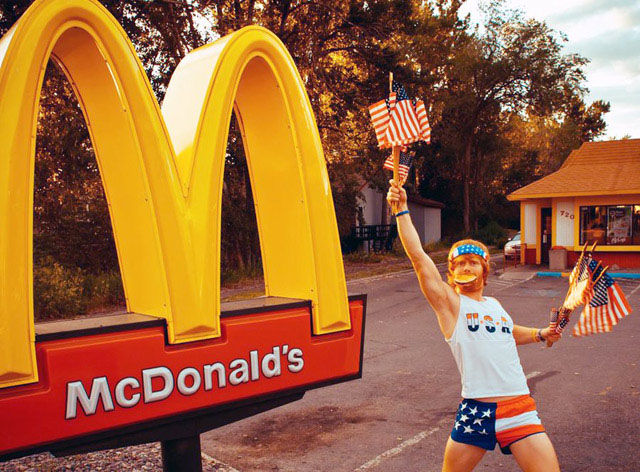
Just give them cheap hamburgers and a bunch of flags. They won't care anymore!

By 1944 or 1945, Nazi Germany would be nearly at the end of their resources, even after pushing the Soviet Union out of their former territory and into Ukraine would mean that German manpower would be nearly at the breaking point. Russia would be in a better position economically, but with the quick attack Stalin wanted to knock out the Nazi's failing, several generals, among them General Zhukov , praised as a Hero of the People just months before, would be getting a bit agitated that a war was started against a nation with the better army. When word reaches the NKVD of the possible public enemy and an attempt to capture Zhukov is defeated by troops loyal to the General, a full blown resistance movement against Stalin takes place. A quick armored dash by Zhukov to Moscow from the front line (made possible when Zhukov negotiates a secret ceasefire with Rommel) and a bloody fight to secure the Kremlin ensue. Stalin, surprised at the speed of Zhukov's rebellion, is captured before he can flee, but is shot while being lead to captivity by a soldier furious at having his family taken away for no reason. Zhukov has himself declared Acting Premier of the Soviet Union, and asks for peace with Nazi Germany, which the exhausted Nazi's accept.

Later Consequences

Nazi Germany's economy is in shambles, the USSR is struggling to reform and come to terms with the Stalin era (and the loss of the Ukraine, Baltic States, their chunk of Poland and Belorussia as German puppet states), Britain is unbowed and slowly returns to it's traditional pastime of Empire Administration, Japan gets a few chunks of land in Siberia and a puppet state in China to boss around, and the US remains out of the war blissfully unaware (or not interested) in what just happened. While Japan would eventually attack the US in the Philippines and Pearl Harbor in the late 1950s, inflicting a huge defeat that snapped American out of it's isolation, that's still a decade in the future. Atomic weapons are eventually discovered, but a landmark deal in 1962 (signed in Cuba, of all places) officially bans their use in war.

...FFS North Korea! You still would try to get them, wouldn't you?
The Nazi Triumvirate finally collapses in 1947 with the death of Goering (officially as a heart attack, in reality a morphine overdose), and soon Himmler and Goebbels struggle to find who will take over sole control. However, the SS eventually is the trump card, and Goebbels is forced out of office, and into exile in the United Kingdom. The Third Reich becomes a strange hybrid of police state, military-industrial complex and neo-pagan ritualists. The Jews, after unofficial pogroms and hatred during and after the Soviet Invasion, are all sent out of Germany, many settling in Libya, Somalia, Madagascar and other African territories of the British and Italians, who are able to keep their land mostly because no one else wanted it.

A five way power struggle comes to a head in the 1970s: The US, UK and USSR (which has finally begun to reform into a something like modern China) versus Nazi Germany and Japan. The Third World War quickly spirals out of control, with Nazi Germany and Japan both launching surprise attacks on the USSR, which brings the US and UK into the war. One atomic bomb launched by Germany on Leningrad shocks the world, and soon nuclear weapons becomes part of this war, though usually only on a tactical level. By 1975, after four years of war, Nazi Europe is invaded on the west and east, and Berlin captured by a very pissed off Russia. Japan would be a tougher nut to crack, with the resources of China at their disposal. By 1977, with Russian forces pushing through China and the US and UK hop-scotching their way across the Pacific and finally landing on the Home Islands, Japan sues for peace. Tens of millions of soldiers and civilians had died, including many in the Western US by a Japanese biological weapon, and the rebuilding of the world would take a long time...

Did anyone bring a shovel? A broom? A Roomba?
Conclusion

Once again, I let the USSR get off lightly by overthrowing Stalin. Man, I seem to do that a lot. I guess I just really don't like him. Can you blame me?

But the big thing I want to point out is that in the 1940s, having only just captured most of Europe and with a very inefficient economy and political system, and the micro-manager that was Adolf Hitler screwing things up, Germany just wasn't in a position to deal with both the UK and the USSR at the same time. Nazi Germany could have dealt with England alone had they had a plan, and they might have been able to stand toe-to-toe with the USSR for a long period of time, However, I think World War Two, and Total War as a theory in general, also shows something else: the nation that was attacked, if they could withstand the air, land and sea attacks that drag them in (the Battle of Britain for the UK, Barbarossa for the USSR, and Pearl Harbor for the US), would be fully unified to engage the enemy. The nation that launched the attack, if not able to mount a quick defeat like the Battle of France, Poland, or the Low Countries and Norway, will be dragged into a war of attrition that they cannot win.

So, I think that if Nazi Germany, due to some reason wasn't able to attack the USSR, and instead the USSR attacked it, I think you would see a reverse Eastern Front: Germany recovering from a surprise attack and pushing east in a bloody slog. But that can only happen if Germany only has to deal with the USSR, and not the UK, and especially not the USA as well.
....damnit, shouldn't have said that...

Friday, October 23, 2015

Flash AH Scenarios #1

Experimenting time again!

I want to try something a bit different today. Instead of one really long article on one Alternate History, I'll just write a couple shorter AH scenarios in one post. Because, well, TL;DR is a thing, as much as I don't like it.  I decided to take a few suggestions from Facebook, but if you have any ideas, leave comments on here, Facebook, Twitter or send me an email.

Anyway, here we go!

What if Alaska Remains Russian?


"Oi!"
From Matt "Mitro" Mitrovich, the author of the Alternate History Weekly Update, comes this idea. And as you know, I'm a sucker for Russian Alternate Histories...

So, POD: William Seward is unable to purchase Alaska (Alyeska) from the Russian Empire due to opposition in Congress to "Seward's Icebox," so the huge landmass remains part of Czar Alexander II's lands, despite the fears that the British would seize it in any future war. For the next few decades, little changes except some minor colonization efforts to establish trading posts, until gold is discovered in the 1890s. Fearing an influx of Americans and British Canadians to tear away this suddenly very valuable colony, the Czar heavily restricts access to Alyeska, only allowing Russian subjects to prospect for gold. A few Americans and Canadians would still make the trek, but the hostile reception, brutal weather, native attacks, and discovery of gold in nearby Yukon make Alyeska less attractive. Raids by Japanese ships in the Russo-Japanese War is a rude wake up call to the very rich colony, and revolts against Nicholas II require armed troops to put down. In World War One, Alyeska provides troops to the Russian cause, and while the regiments from Alyeska are highly respected, they are unable to majorly turn the tide of the war.

With the Russian Revolutions, Alyeska is divided between Whites and Reds, and the British, using Canadian troops, temporarily occupy New Archangel (OTL Sitka) and Alyeskagrad (OTL Anchorage), before war weariness force them out. Eventually the Communists come to power in Russia and in Alyeska, which is upgraded to become a full fledged Soviet Socialist Republic. Stalin's brutal industrialization hit Alyeska hard due to the demands of raw materials and gold to pay from foreign supplies unavailable in the USSR, as did the need to station troops in Alyeska to combat possible American and British aggression. In World War II, Alyeska was a major stopping point for American and Canadian ships providing Lend-Lease to the USSR, and Alyeska provided troops to fight on the Eastern Front.

After the war, Alyeska became a major battle ground of the Cold War. With a stepping stone straight into North America and the United States, Alyeska became a major military outpost, with bombers, tanks, and tens of thousands of infantry ready to sweep into Yukon and British Columbia in an instant. The Alyeskan Missile Crisis nearly lead to nuclear war in 1962, but negotiations managed to resolve the issue by the removal of nuclear missiles from Alyeska. The discovery of oil gave a huge boost to the faltering Soviet Economy of the 1970s and 1980s, and once again made Alyeska the most valuable Russian territory. However, it wasn't enough to prevent the collapse of the USSR, and in 1991, Alyeska went independent, establishing a capitalist society and building very close ties to a relieved US. While not a fully democratic nation due to the long Russian and Soviet legacy, Alyeska is one of wealthiest of the former Russian states, and secrets are still emerging, such as the covered up sinking of a Soviet Oil Tanker in 1989 that caused huge amounts of damage to the coast and shore line.

What if Cortés Failed to Conquer the Aztecs?


Well just take these people up to this tower... and kill them so
the sun will still rise tomorrow. Got it? 
Esarhaddon Asshur on Facebook asked what would happen if Hernán Cortés' attempts to gain indigenous allies to overthrow the Aztecs failed. Well, here's the answer.

With the death of Cortés and his men, mostly due to his lack of desire to make any sort of alliance with the natives, even those oppressed by the Aztecs themselves, the Governor of Cuba refused to allow any more expeditions to the mainland, seeing it as a waste of time. Smallpox then swept through the Aztec Empire and the rest of the Americas, killing almost 90% of the native population, by the time that the Spanish tried to invade Mexico again, the Aztecs had begun to adapt, mostly thanks to the capture of several Spanish soldiers who were not sacrificed, but instead allowed to spread European technology and ideas among the Aztecs. By 1600, with the worst of the Smallpox over, the Aztecs had begun to modernize their empire. In one last reform, the aging emperor of the Aztecs allowed himself to be sacrificed to the Gods, the last human sacrifice allowed by the Empire. From then on, non-human sacrifice was conducted, the blood debt considered repaid.

When the Spanish tried to invade Mexico again, they came up against a people who, while speaking a different language and with a different culture, had weapons similar to the Spanish, and new tactics that lead to yet another bloody defeat. After this, the Spanish would simply try to trade with the growing and expanding Aztec Empire, which was pushing north to the OLT Rio Grande River, and south to Panama. An uneasy peace would exist for years, and it was only in the 1670s that another major war broke out, this time with the Aztecs allied with the British against the long time enemies in Iberia.

The Aztecs would continue to go from strength to strength, but by the 1720s, the Aztec Empire was crumbling. Vast distances with few roads and communications, the depletion of gold mines that was used to pay for European technology, and the resentment of dozens of tribes, and a constant schism over the end of human sacrifice eventually lead to a brutal civil war. The Spanish once again tried to sway the outcome, but eventually the entire Empire fractured into quarreling states, with a few European outposts on the coasts. It wouldn't be until the 1800s that a unification movement, inspired by the American and French Revolutions would take place. While this unified Mexico as a mostly democratic nation, Mexico's economy and politics would continue to be unstable. Today Mexico is a popular tourist destination, but the ongoing American occupation of Northern Mexico in response to terrorist attacks on Texas and California in the 1980s is a source of unrest and anger that is just threatening to burst open.

What if King Henry VII of England Sponsors Christopher Columbus?


The smirk of a man that found, colonized, and killed most of
America... makes you want to punch him, no?
The last scenario I'm going to write about today is from Andy Dowless, once again on Facebook, about a slightly different colonization of the New World.

Arriving in OTL Nova Scotia in 1492, Columbus believes at first that he found China or India, but the cold weather, suspicious natives, and lack of any kind of cities (and gold, as the natives had no gold jewellery) quickly changes his tune. However, he realizes that it would be a great land to settle, due to the abundant fish, trees, and arable land. He spends a couple of weeks mapping the coast line, before finding a massive harbor, which he names Henrytown (OTL Halifax).

With this news, he hurries back to England in the spring of 1493 with some samples of trees, lots of cod and a few natives (all but three dying on route), and tells the court of King Henry VII of an unspoiled land, great fishing, massive trees, and a few inhabitants that know nothing of Christianity. He's certain he has found a new land, and sought to establish a colony at the harbour he found. King Henry VII at first isn't impressed, but with Columbus' constant lobbying, eventually the exasperated King agrees, sending Columbus back to this Terra Nova to settle in the name of "God, the King, and England."

The colonization of Terra Nova is very slow, even as native tribes are wiped out by smallpox (everyone's favourite contagious disease) which leaves even larger areas to colonize. The Spanish and French, hearing of this new land, but not of any gold or riches, pretty much ignore the discovery, and continue their European wars. Columbus settles down as the governor of his new Colony, slowly expanding outward, exploring the coastline, and eventually finding Newfoundland, OTL Montreal, and south to Long Island and OTL New York City. Only the lack of colonists prevent Columbus from establishing more colonies, much to his disappointment. Columbus died in 1506 in Henrytown, a respected governor of the Colony named Canada, the explorer who found a new land (though, yes, the Vikings found it before...). While the entire Atlantic coastline of OTL North and South America was mapped by 1550, colonization in Central and Southern America was a lot slower than up north, mostly restricted to trading. This allowed groups like the Aztecs and Inca to gain more advanced technology like swords, armor, horses, and even small ships, as well as the ever present Smallpox, spurring a huge cultural, economic, and political revolution the totally changed how Mesoamerican nations interacted.

Over 150 years of lacklustre colonization in North America then takes place, with a couple boatloads of adventurers, the poor, and religious refuges coming every few years. All this changes in the 1650s. The English Civil War breaks out, and soon hundreds of people are seeking to flee England, wishing to find a place free from war. The stories of wealth and gold in Aztec and Inca territory finally encourage the Spanish, French, Portuguese, Swedish and Dutch to try to colonize their chunk of Terra Nova, but most of the hastily assembled invasions and arrogant colonists are destroyed by the equally advanced Natives, allied with England. The native tribes in Northern Terra Nova also begin to adapt, and soon all of Terra Nova in a huge collection of independent tribes and empires, with a few European colonies which are eclipsed in size, wealth and population by Canada, stretching from the capital of Henryton as far south as OTL Virginia, east to the Great Lakes, and north to Labrador.

In other words...
Sorry about that.

Tuesday, October 20, 2015

Editorial: The Results of Alternate History Elections

Yesterday was Election Night in Canada. Well, it will be yesterday when this is published, as I'm writing this on Monday. Yay for future writing!

Anyway, even though Justin Trudeau of the Liberal Party lead a Red Sweep of the Election (and I added this as soon as I heard the CBC Projection), I'm not here to talk about the actual election, as shocking as the release of the results were. Instead, I want to spend a few minutes talking about elections in Alternate History, or rather, the different outcomes that can come out of it. Mostly because, as a politics geek that also does alternate history, I try my best to put together the actual elections in my timelines, and I want to see other people do it as well.

But here is the list of the elections that you usually see in Alternate History scenarios...

And select which of the following points you like most!

1: The "Meh, Same as OTL" Elections

These are the ones where someone doesn't even bother rewriting history, unless it's just to place a different name in place of the different candidates. If feeling really ambitious, sometimes the colours of the parties on the nice big map is reversed as well, just to confuse everyone. There are a lot of first time alternate histories that devolve into this, though hints of it can be seen in bigger works. 

This is usually a sign that the Alternate Historian just doesn't give a damn about politics, but wants to flesh out their world. Maybe they are more focused on the culture, wars, or sports of their TL, which is fine. But the problem is, they are just copy-pasting the results for Wikipedia without understanding why it happened, and giving few answers as too why. And, as my first year politics professor at University told me, everything is political. Why one movie is banned while another one is allowed to be shown? Politics. Why a nation, or a coalition of nations decides to bomb and invade another? Politics. And why does one team have a brand new sports stadium, or is moved to another city? Once again, politics.

"Everything is Art. Everything is Politics." -Thomas Mann

If it's a "secret history," then it makes sense. Of course, that's not what I talk about in this blog, it's alternate history. Even taking the butterfly effect into account or not, there will be some different outcomes in elections if things go differently. Could Abraham Lincoln have won a second term if Atlanta wasn't captured just a few weeks before? Would Dwight Eisenhower be able to be nominated, much less win the presidency, if he wasn't the Supreme Allied Commander in Europe? Could Winston Churchill be named Prime Minister if the UK never entered World War Two? In all these cases, I feel the answer is no. So, just take a few minutes, do a little of research on Wikipedia, and try to make the Political leader in charge at least be somewhat realistic, or at least try to tie it into the timeline better.

2: The "Straw Man/Mary Sue" Elections

Basically this is when the elected official that is the primary focus of the work either leads the country into disaster or into a golden age based on their policies, and is pretty much used by the author in order to show how their preferred or opposing candidate would run the nation. This is usually two sides of the same coin, and almost always devolves into political bias, and it's pretty easy to tell the author's bias. An Independent in 2000 on the AltHistory Wiki is an example, as well as A World of Laughter, A World of Tears where Walt Disney is elected President of the US when Eisenhower isn't able to run in 1956. Believe me, it really does not end well. The West Wing might be a TV example, though not to the same degree as their other ones mentioned here.

Though, Aaron Sorkin has pretty much made this a liberal fantasy. According to every conservative person ever.

I'll be honest, I hate these kinds of elections/politics in alternate history, even though some of these, World of Laughter especially, are very well written. It's just how implausible most of them are, where the recently elected official, usually the President of the US, is able to put into practice all of the stuff he wants to do soon in office, the Congress passes it all, and the repercussions are either leading the country to total ruin, a new tyrannical dystopia, or starting a new utopia of whatever colour stripe the author is.

If anyone follows American politics, especially of the last 15 years, it should be pretty clear that it just can't happen like that. President Obama managed to get the Affordable Healthcare Act through Congress before a massive Tea Party inspired backlash managed to put the Republican party in control the House of Representatives and the Senate. Ever since then political gridlock has held the government in the US hostage. It's fair to say that if a very liberal Democrat got into office, no matter real life or alternate history, that the Republicans could mount similar tactics to what has happened today, and vice versa. And it's really rare where political programs not only work as advertised, but even better. For all the great things the New Deal did, most of them actually really didn't do much in the long run besides immediate relief, and many were struck down by the Supreme Court or Democrats that thought Roosevelt was going to far.

The wheelchair told him to do it.
3. The "Nazi Party" Election

This is a very extreme form of the election I mentioned above, and basically it involves a party with a few questionable policies but a charismatic and forceful leader taking advantage of a political or economic crisis to not only run in an election, but win. This would then be followed by dismantling democracy, jailing dissidents, pushing propaganda on the rest of the populace (along with a brutal secret police) and plotting how to glorify the nation, or have it catch up with a competitor.

I call it this because this is exactly how Adolf Hitler and the Nazi Party came to power in Germany. And in alternate history I have no problem with this kind of scenario, but only if it's done right. Harry Turtledove's Timeline 191 series did this for the Confederate States of America, with Jake Featherstone and his fascists, racist Liberty Party winning the elections to not only the Presidency by the CS Congress. So, while some of the things felt a bit suspicious (like trying to get the Supreme Court to vote itself irelevent... what?) over all it's a fairly good example. I still have to see if maybe Turtledove's Joe Steele, which is still sitting on my bookshelf unread as I write this, handles it just as well.

Oh this will be a nice book. I'm sure of it...
But in many circumstances how it comes about is complete baloney. The background to such an event has to make sense: economic disaster, a resentful nation with a humiliating peace treaty, and/or a political gridlock and division that makes the other problems even worse when no one can deal with it. It's not possible for a nation that has a strong democratic tradition, with a respected constitution and government structure, when everything is going alright (well, mostly alright; nothing is perfect after all) to then suddenly allow a dictator to come to power, even if legally through elections. It's only in the most desperate moments: a losing war, an even worse Great Depression, a general feeling of misery and anger, that allows demagogues to come to power.

4. The "Screw the Smaller Elections, Just the President Matters" Election

This is the one where the writer just doesn't give a crap about the hundreds of congresspeople, Members of Parliament, or whatever title is given to the representatives of the people that are voted. No, the only vote that's important is the guy at the top: the President, the Prime Minister, the Big Cheese. After all, that's the guy that get's the nuclear briefcase, the big house, and the ability to basically shut down all TV stations to just say hi.

"My fellow Americans... how are you? Why won't you call? Don't you still love me???"
These AH's focus on the Head of Government (or Head of State) as the primary source of power in a nation. While some nations might be like that (*coughPutincough*), most democracies try to balance it out between the Legislative, Executive and Judicial branch, preventing one person from dominating the government.

This is different from the previous point I made, mostly in that while the nation may still be democratic, but the writer only focuses on the top leader. I can see why some people would do this, but I think it's also important that, even if the focus is on the leader of the party, that at least the numbers of the representatives who will be elected and have to work with the President.

5. The "I've Done My Homework" Election

Theses are really hard to pull off, and usually you will only see these take place in made up nations, not real ones. When working on one like this, the big colorful maps with all the ridings, electoral districts, or Electoral College votes plotted out, the math done, and believable candidates with platforms that make sense, politicking, debates, etc. etc...

After all, no one would ever believe it if you did something like this in fiction...
The only problem with these ones is how hard they can be to put together. First, in an alternate history, maybe populations have shifted, or new states or provinces are there, and others aren't. But a very dedicated, map fanatic Alternate historian will go so far as to make their own electoral maps, election rules, and run the election. Of course, if the rules are changed they could make it easier on themselves and do away with the maps all together, and instead focus on proportional representation or other forms of voting. Because, let's face it, saying a party got 35% of the vote is easier than making up hundreds names, numbers and candidates, all for one alternate history.

As much as I like these AH Elections, I still want to see an actual story, not just focused on the election. You could make 338 articles on every riding in Canada, or the 650 some in the House of Commons of the United Kingdom... but we only have so much time and energy.

6. The "Elections? What Are Elections?" Election

1984 writ large. It's not just Oceania that doesn't have a democracy, but every nation in the world. It could come in different flavors: communism, fascism, military dictatorship, technocracy. Basically elections aren't even necessary, and will most likely never be held, or restricted to only certain people. Frankly, this is just a story driven one, as even North Korea has to stage elections, though it's a "everyone will vote for the one candidate or you will be shot" kind. You will not see these in real life, no matter who brutal the dictatorship.

Seriously? You don't even try Big Brother? Wow...
This has just been a short look at some of the different ways elections are handled in Alternate Histories. While each of the ways mentioned above have their place, in most places I want more Number 5 kinds, but those are pretty tough to make, so even just a Number 4 would be okay... Number 3 and 6 if they fit into the story. I really, really want 1 and 2 to be completely done away with, but it will be hard to remove those.

At least we have elections to determine this!

Friday, October 16, 2015

AltHistory Scenario #12: What if Winston Churchill Died in the Boer War?

Ahhh, good old Sir Winston Churchill, the saviour of democracy (and the British Empire) in World War Two, a witty public speaker, and also a pretty good writer of history. Sure, he was the guy that had the brilliant idea of sending troops to Gallipoli, and also advocated for the arrest or even execution of Mahatma Gandhi, and also to keep millions of people under undemocratic colonial governments... but, you know, no one is perfect.

However, Churchill first came to public attention during the Boer War, one of those imperial scuffles that fill the history books, where the people in charge and the people living in an area not only are different but don't see eye to eye, and eventually just leads to armed conflict. Churchill was a war correspondent there, after serving in the Sudan and India, and was captured as a Prisoner of War when the armoured train he was riding in was ambushed. What if, instead, he was killed in that ambush?
Nothing like saying "This is pretty darn important" than having machine guns on a train.

Point of Divergence

Well... I think already mentioned how I wanted to change history this time. If you didn't get it, read the previous paragraph again.

Immediate Consequences

Churchill was a national hero when he returned from South Africa, and used it to get elected to the House of Commons, which he would sit in for the next sixty some years, on both Liberal and Conservative benches, in and out of power, and Prime Minister twice. The effects of the lack Churchill's presence wouldn't be felt until 1910, and the constitutional crisis of the period that eventually lead to the "People's Budget" of 1910 and the Parliament Act of 1911.  In both cases, Churchill supported and actively argued for the passage of both acts, but I feel that at this point he wasn't the deciding factor, so both would still be passed.

The next change would be 1911, when Churchill was made the First Lord of the Admiralty. Immediately he advocated that the coal fired ships of the Royal Navy, namely the big battleships, be converted to oil power, which was mostly achieved by 1913. Without Churchill to push for this reform, despite the approval of admirals like the famously argumentative and reform minded "Jackie" Fisher, it could take a longer period of time for oil to be adopted. This had the side effect where the British government wouldn't invest in the Anglo-Persian Oil Company, which, in the complicated history of business mergers and breakups, would eventually become British Petroleum, aka BP.

So, Gulf Coast residents, blame Winston Churchill for Deepwater Horizon!

In World War One, Churchill was still the First Lord, and pushed for the invasion of Gallipoli to capture Constantinople and force the Ottoman Empire from the war. Without Churchill to propose it, I wouldn't think that the British and French would try for an invasion of the Dardanelles, which also lead to the popular rise of an Ottoman solider who would later become known as Ataturk, the first President of a democratic Turkey...

Another thing Churchill got the Admiralty to investigate was "landships," to be used to break the stalemate of World War One. Without Churchill, the development of the tanks that helped the Allies win World War One wouldn't be developed until later, (they first arrived on the battlefield in 1916) and possibly still be in their infant stages in the next one.

World War One's result would not be much different, despite the lack of tanks, the possibility that the German navy could have been more successful against the still coal-fired Dreadnoughts of the British, but without the distraction of the Gallipoli campaign. So, in the end it would be a wash.

So... yay?

Later Consequences

However, World War Two is where Churchill's influence is most felt, and the area that will really be changed without Winston. As the PM of Britain in it's darkest hour, he was able to rally the British and prepare them for a long, bloody war. After the Fall of Poland, France, Norway, and the Low Countries. The Royal Navy would have been able to hold it's own, but with the evacuation of the British Expeditionary Force from Dunkirk, made possible when Hitler called a halt to the attack, the British people's desire for peace would come to the forefront.

A few more months of Phoney War, with limited air foray's by both forces to at least make it look like something was happening, but by August 1940, less than a year after the war started, a negotiated peace between Nazi Germany and the United Kingdom would take place. France was reformed, minus Alsace-Lorraine and some other land and shorn of it's colonies to be given to Germany, and Germany would pay the British for damages caused to British and Imperial forces in the war. The War in the West was over by Christmas.

Let's face it, this picture is one of the better tourist pictures taken in France in the past 100 some years.

However, this only dealt with Europe, at least as far as the British are concerned. In May, without having to rescue Mussolini from being trounced by the British in Egypt and Greece, Hitler would unleash his Blitzkrieg on the Soviet Union. With another month of prime campaigning weather on the Steppes, German armies would reach Moscow before it snows, killing Joseph Stalin in the desperate battle to try to hold the Germans back. With the Swastika over Moscow and Stalin dead, the Soviet Union completely fractures. A new Civil War between Stalin loyalists, supporters of the recently deceased Trotsky, monarchists, republicans, anarchists and fascists would all rise up and try to claim their own chunk of Russia. Germany, despite it's intentions of just claiming the land for their own use, would be dragged into this increasingly bloody battle, which would slowly wear down their strength, but not enough to collapse the Third Reich.

By mid-1941, relations between Japan, the UK and the US were falling, and with a surprise attack on Hong Kong and Pearl Harbor respectfully in December, both powers were dragged into war with Japan. Continued reverses, Japanese surprise attacks, difficult relations between the US (Roosevelt would be voted out in 1940, since there was no war in Europe for him to prepare America for) and the British would mean that the two powerful nations would spend more time squabbling than planning a combined strategy to defeat Japan. By 1944, war exhaustion in both Britain and the UK would lead to both nations finally making peace with a more powerful Japan. The world was finally back at peace, and in a totally different shape than before.

Somehow Japan always seems to come out of WWII Alternate History's pretty unscathed... Lucky bastards.

The British Empire would continue to survive, minus a few colonies in the Pacific (Australia and New Zealand would still be independent of the Japanese, but fear of a new invasion means both nations are heavily armed), and eventually India and the African colonies would be given Dominion status in a reformed Commonwealth, mostly because the British were still powerful enough to maintain military presence in the Colonies, but desire to cut costs would be the big reason that would happen. The Royal Navy still rules the waves, though mostly in the Eastern Atlantic.

As for the rest of the world, the United States would return to isolationism, not wanting to get dragged into another war with Japan, and sure as hell not Germany. Japan would be quite content with their Co-Prosperity Sphere, and soon would become a major economic power to rival their military success. Japan, the US and the UK all eye each other warily, still expecting a big war someday.

It will most likely break out because of THIS misunderstanding...

Germany, on the other hand, wouldn't be so lucky. While at the peak of their power after 1945, including detonating the first atomic bomb in occupied Ukraine in 1949 (the US got the bomb in 1950, the UK in 1954, and Japan by 1958), the exile of the "Jewish problem" to Madagascar and the German colonies in Southern Africa, and presiding over the occupation and subjection of all of Europe the death of Adolf Hitler (officially a heart attack, unofficially some syphilitic disease) by 1955 would result in the entire structure collapsing. Brutal struggles between Goering, Goebbels, Himmler, Rommel and other big name Nazi's would see the Third Reich be broken up into rival fiefdoms, armed with tanks, atom bombs and conscript armies. For years this Civil War would continue until an uneasy peace is made in 1962. The Nazi Empire is reunified under Erwin Rommel as the other big wigs die, some from suspicious causes, who makes it slightly more democratic, somewhat more stable, and significantly less insane. Russia is still a chaotic, anarchic mess that no one wants to deal with, and Latin America just switches between one Banana Republic dictator to another, just so long as American business interests are left alone.

Because why deal with the complicated cultural, political, historical, and linguistic differences of a huge chunk of the world when you can just ignore it?

By 1970, the Four Atomic Powers are now in a Cold War, much as Churchill had said would happen in 1946 when speaking in the US of the Iron Curtain. While proxy wars on the periphery of the major power's sphere of influences would continue, the Cold War still continues today.

Conclusion

For all his faults (and there are quite a few), I still believe that Winston Churchill is one of the most important men in world history, if just because he had a good strategic vision of how to win World War Two, if a flawed tactical expertise as Dardanelles, Crete and Italy showed. He was a brilliant speaker, a great writer, and did what he thought was best of the British people. If that meant a little self promotion, allowing the Empire to fracture, or working with his hated enemies in Soviet Russia, so be it.

Winston Churchill, 90 years of quotes and witty combacks that will last forever.

Without Churchill to rally the British people in May 1940, it's fair to say that the world would be in a lot darker place than it is now. It's a testament that, even when Britain was mostly alone, with the colonies thousands of miles away and months, if not years, away from supplying the homeland, the US still staunchly isolationist and facing down the greatest evil of modern times, Churchill would stand up in the House of Commons, and say that Britain, protected by the few of the RAF, would fight on the beaches and landing fields, never surrender. He rallied a people that just months before were willing to give in to Hitler's demands

If you think words have no meaning, look no further than Churchill